
More Information
Submitted: February 28, 2026 | Accepted: March 13, 2026 | Published: March 16, 2026
Citation: Bradley RT. Holographic Processing in Neural and Psychosocial Systems. Int J Phys Res Appl. 2026; 9(3): 043-061. Available from:
https://dx.doi.org/10.29328/journal.ijpra.1001146
DOI: 10.29328/journal.ijpra.1001146
Copyright license: © 2026 Bradley RT. This is an open access article distributed under the Creative Commons Attribution License, which permits unrestricted use, distribution, and reproduction in any medium, provided the original work is propeRLy cited.
Keywords: Holographic processing; Neural microstructure; Gabor processing; Fourier processing; Quantum holography; Information processing; Sensory perception; Motor function; Purposeful action; Spectral domain; Psychosocial systems

Holographic Processing in Neural and Psychosocial Systems
Raymond T Bradley*
Director, Research Center, Institute for Whole Social Science, Northland, New Zealand
*Address for Correspondence: Dr. Raymond Bradley, Director, Research Center, Institute for Whole Social Science, Northland, New Zealand, Email: [email protected]
With his application of the physics of image and information processing in research on the brain, the late, world-renowned neuropsychologist, Karl Pribram, illuminated the inner workings of neural processes with his holographic approach. Pribram shows that both Gabor processing and Fourier processing are involved in processing in the neural microstructure, and that memory/retrieval, sensory perception, and motor function, can all be understood in the terms of holographic processing, which is extended, here, to purposeful action. In collaborative work, Bradley and Pribram applied Gabor processing to show how social communication in groups, via the field of affective attachment among members, distributes quantized holographic-like units of information about collective order to generate functionally effective patterns of organization.
In the fifteen or more years since this striking resemblance between holography and certain brain/behavioral processes was noted, much evidence has accumulated to show that what began as a metaphorical simile has been developed into a precise neurological model.
Such a theory is thoroughly grounded in the structures and functions of the microanatomical connectivity of the nervous system and provides a mathematically sophisticated formalism of the relationship between anatomy and memory structure.
… There is little remaining doubt that some brain processes are characterized by holonomic transformations that result in algebraic isomorphisms between image/object on the one hand and the holographic transform domain on the other Karl H. Pribram [1,2].
“Hidden behind the discrete and independent objects of the sense world is an entangled realm [quantum reality] in which the simple notions of identity and locality no longer apply.” [3]…. and at the scale in which we navigate our [4-D spacetime] world, is a hidden holographic universe in which are embedded the objects we perceive with our senses and actions. The enfolded realm spans all scales of inquiry from cosmic through brain processing to quantum fields Karl H. Pribram [4].
Prologue
Psychologist Karl Lashley was the late, world-renowned neuropsychologist Karl Pribram’s mentor. Lashley conducted a lifetime of experiments teaching rats to learn a maze after which he surgically removed a portion of the visual cortex, in searching for the engram (the location of the memory image of the maze path). Despite surgical excision of almost all the visual cortex, the rats could still find their way through the maze! This left Lashley exasperated, a result for which he had no answer. After learning about Gabor’s discovery of holographic organization, Pribram realized that the principle of distributed organization of information—namely, that information about an object (as a whole) is recorded at all points and locations throughout a field by the movement of energy—appeared to offer a way of explaining Lashley’s paradoxical result. To resolve the paradox, Pribram had to venture deeply into the principles of holography—viz, the physics of image and information processing.
As “sentient” creatures, we have awareness of feelings that signal, on a moment-by-moment basis, the disposition of our life experience. Our sensory perception, our movement, our thoughts and knowledge, and our plans and strategies for action “[come] to the mind in the form of images”, neurologist Antonio Damasio writes. But he asks, “How do [our brains] come to create these marvelous constructions?”
… the neural activity that is most closely related to the images we experience occurs in the early sensory cortices and not in other regions. … whether [this] is engaged by perception or by recall of memories, is a result … of complex processes operating behind the scenes, in numerous regions of the cerebral cortex and of neuron nuclei beneath the cortex, in basal ganglia, brain stem, and elsewhere [5].
In the seven decades of research before his passing in 2015, Pribram delved in depth into “these complex processes operating behind the scenes”. In his quest for understanding, Pribram found a viable approach in the physics of image [6] and information processing [7]. In his application of this approach, Pribram was able to show how neural processing of memory/retrieval, sensory perception, and motor function can all be understood in terms of holographic processing [8]. Building upon Pribram’s approach, a model of holographic processing extends this to purposeful action.
The paper proceeds in three stages: first, the signal-processing and neural basis of holographic processing; second, its application to purposeful action and psychosocial organization; and third, a brief consideration of broader implications.
The brain as a ‘pattern matching’ computer
A crucial development in Pribram’s work was a collaborative project, Plans and the Structure of Behavior, in which he and his co-authors and viewed brain processes in terms of computer processing [9]. Upon publication, the book stimulated a veritable revolution in brain science and psychology, facilitating the shift from behaviorism to a cognitive approach in which the animal or human interacted in their world with a thinking brain. Neural scientist Joseph LeDoux describes the utility of this approach:
Cognitive science treats minds like computers …. [It] has been very successful, and provided a framework that, when appropriately applied, provides an immensely valuable approach for pursuing the emotional as well as the cognitive mind [10].
Adopting the metaphor of a computer, Pribram and his collaborators viewed the brain as a programmable pattern-identifying and matching system [9]. Beginning by viewing neural processing as a “controllable thermostat”—viz, as a means of embodying, in systems logic, “behavior [that] is controlled by the operations of an organism to fulfill an aim”, they moved to the circuitry of a rheostat,1 because its logic was more appropriate for the brain as a regulator of a “programmable, adjustable process” [4]. This led them to view the basic logic of neural processing as a servomechanism (TOTE)2 incorporating parallel processing with feedback and feed-forward control circuitry. A radical alternative to the dogma of behaviorism in psychology at the time, their approach was based on the postulate that the individual (animal or human) was purposeful, pursuing an “aim” or a “plan” in their interactions in the world (Figure 1). Today, this approach is known as cognitive science. Yet for Pribram, the computational metaphor remained provisional; the deeper issue was how distributed neural processing could generate stable images for memory, sensory perception, and purposeful action.
_________________________________________________________________________________________________
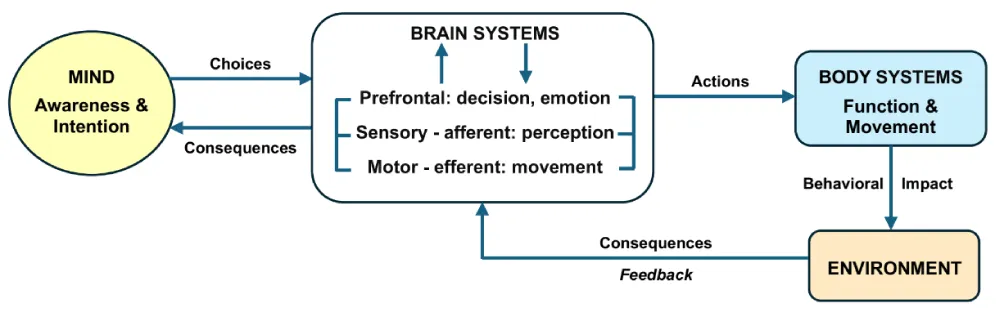
Figure 1: Schematic Showing Relations Among Mind, Brain, Body, and Environment Regarding Choices, Actions, and Consequences. A highly simplified schematic of Purposeful Action (behavior in pursuit of an aim/goal). Highlighted is feed forward - feedback parallel processing of the primary Brain Systems involved in implementing and monitoring the actions of the Body’s various systems, which, as behaviors, impact the Environment and result in various consequences. The consequences are perceived by sensory perceptual systems, and enable conscious adjustment of the choices which, in turn, produce modifications in motor control to change body function and movement, in adjusting behavior to better achieve the Plan. (© copyright, 2026, R. T. Bradley, Institute for Whole Social Science.)
Feedback and feed forward regulation
Depicted in cybernetic terms, Figure 2 shows how Pribram viewed the brain as a control regulator for body systems’ function and behavior. The baseline mode of the system (bottom circuitry) shows the brain’s default ‘setpoint’ for system stability. It prompts this level of system behavior, which it regulates through feedback of input from internal and external sources, which is compared against the setpoint. A discrepancy between the two causes the brain to prompt the system to adjust its activity, accordingly, thereby restoring system stability. To change the level of body function requires establishing a new “setpoint” of system control (top circuitry). This is shown as the red ‘feed forward’ arrow by which the brain ‘resets’ system function to the new level. Locking this in requires repeated cycles of system activity at this level for it to become the “familiar” state and, thus, be instantiated in the neural architecture.
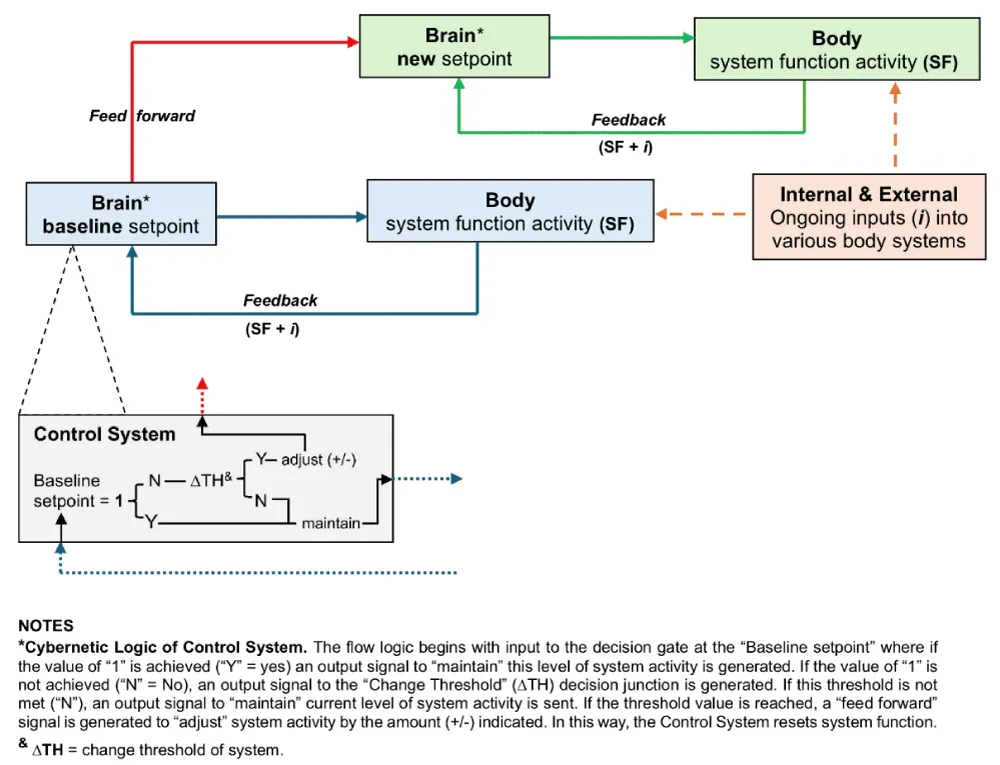
Figure 2: Logic of Brain as a Control Regulator for Body System Function Depicted in a highly simplified schematic form, is how the brain operates as a control system to regulate functions of the body. Note: the internal logic of the brain as a “control system” is depicted in cybernetic terms beneath the figure, in the gray shaded box. It shows the flow logic of inputs/outputs at the “Baseline Setpoint” and “Change Threshold of System” decision gates. The baseline mode of the system is shown in blue (bottom circuitry), wherein the brain’s baseline “setpoint” for system stability prompts this level of system behavior which it regulates through a feedback informational input to the brain—including that from internal and external sources, which is compared against the setpoint. A “mismatch” between the two causes the brain to prompt the system to adjust its function accordingly, to bring the system back to stability. To change the activity level of body function requires establishing a new “setpoint” of system control in the brain. This is shown as the red arrow by which the brain has “reset” the desired/target state of the system to new level of function, shown in green (upper circuitry). Establishment of a new level of system function requires repeated cycles of system behavior at this level for this behavior to become habituated—in Pribram’s terms the “familiar” state (© copyright, 2025, R.T. Bradley, Institute for Whole Social Science.)
As a “novel” (new) situation is repeatedly experienced, these inputs are reinforced in the neural architecture as the ‘familiar’ (habitual) pattern and encoded as memory. In this way, the current reference pattern in the brain—its baseline setpoint—becomes modified, and the control circuitry is fed-forward to this ‘new’ setpoint. This shifts system activity to this new level (top circuit, Figure 2). From this point on, the system automatically strives to maintain a match with inputs that sustain the new level of activity, which is now the baseline setting [4].
Typically, this reset process occurs automatically and unconsciously. However, a feed-forward system reset process can be intentionally induced. This occurs as a pattern-matching operation in which the individual engages their mind to intentionally focus on a new emotional, cognitive, or behavioral target, a ‘Plan’.
Purposeful action
Pribram defines a “Plan” as the “image of achievement” which precedes purposeful acts. This is a neurological image (an internal representation) of the “target” of achievement [11]. Hence, holding the new Plan in mind as the target of achievement induces the neural architecture to instantiate a feed-forward circuit as new patterns of input are repeatedly experienced, so that the match between target and repeated experience is stabilized as the new setpoint [8]. This is illustrated in Figure 3. A with the example of an intentional reset of the autonomic system using an emotional management technique which holds ‘heart coherence’ in mind as the intended target3. While Figure 3B shows electrophysiological recordings from an individual to illustrate the self-initiated system reset process, the Institute of HeartMath has conducted many studies confirming self-induced shift to Heart Coherence in various populations [12,13].This includes a field experiment involving 10th grade high school students (Experiment Group, N = 48; Control Group, N = 50) where the Experiment Group students shift to coherence produced statistically significant differences on all five measures of heart rate variability in an Analysis of Covariance (ANCOVA) [14]. The heart coherence example is used here as an illustrative case of intentional feed-forward resetting, not as part of the evidential basis of the holographic argument. Later, we’ll come back to Pribram’s concept of “image of achievement” to describe the holographic processing involved in such purposeful action.
____________________________________________________________________________________________________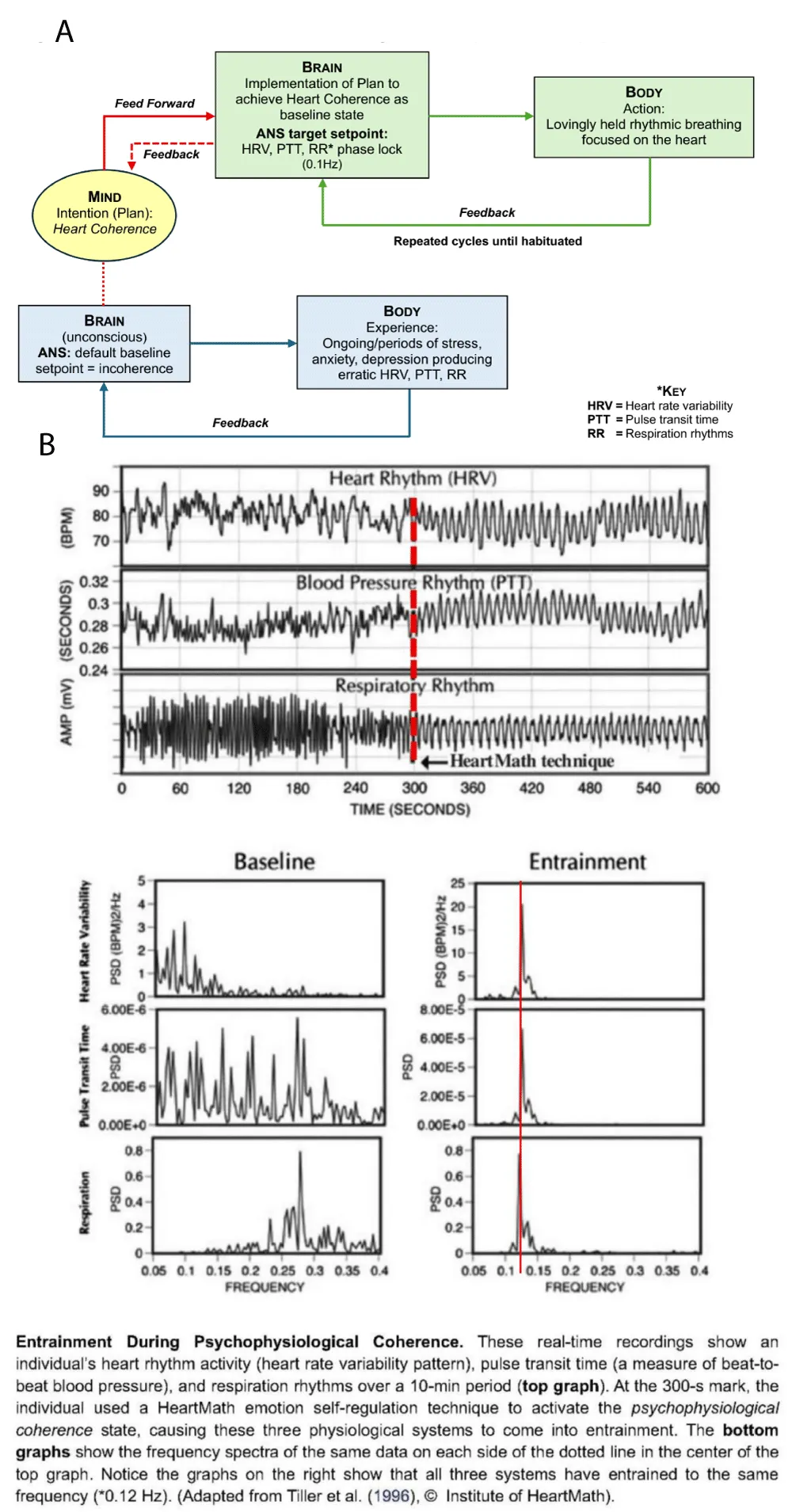
Figure 3: Example of Intentional Shift to Heart Coherence as a Feed Forward Process A. The figure shows how an intentional shift to induce a state of heart coherence, when repeated daily, can reset the baseline setpoint for the psychophysiological system. By engaging the conscious Mind, the individual is able to intentionally shift their body’s psychophysiological baseline function from a negative emotional state (e.g., stress/anxiety/depression, etc.) to a positive emotional state such as love, appreciation, gratitude, and so forth. Note: I have simplified the diagram by leaving aside the external environment; viz, its impact on the individual and the impact of their actions upon it. (© copyright, 2026, R.T. Bradley, Institute for Whole Social Science.) B. These real-time recordings show an individual’s heart rhythm activity (heart rate variability pattern—HRV), pulse transit time (PTT, a measure of beat-to-beat blood pressure), and respiration rhythms (RR) over a 10-minute period (top graph). At the 300-second mark (red dashed line), the individual used a HeartMath emotion self-regulation technique to intentionally activate the psychophysiological state—viz, to self-induce a change from a negative feeling of “frustration” to a positive feeling of “appreciation”. The instant the coherence state is activated, an immediate shift to coherence is evident across all three systems as they are frequency-pulled by heart’s rhythmic pattern into entrainment. This is shown in the graphs as a rapid change from an erratic, disordered (incoherent) heart rhythm pattern associated with “frustration” (left) to a smooth, harmonious, sine-wave-like (coherent) pattern induced by “appreciation” (right). The bottom graphs show the ECG electromagnetic spectra of the three recordings above. As is clearly evident, whereas the Baseline measure for each system (HRV, PTT, and respiration) is spread across the frequency spectrum (left), once the individual shifts into a sustained state of coherence, the spectra for the three systems have come into a state of entrainment at the same frequency (0.12 Hz; marked by the thin red vertical line)—viz, a state of system wide coherence. Research has consistently shown that the coherence state is associated with optimal psychophysiological function and performance [12,13](Tiller et al., 1996; McCraty et al., 2006, © copyright 2006, Institute of HeartMath; adapted and reproduced with permission.)
Neural processing
Pribram’s research on the distributed (nonlocalized) organization of memory [11,15], the experiments by DeValois and DeValois [16,17] on vision, and Von Békésy [18] on audition, along with the results from other studies4, provided a compelling body of evidence that memory and sensory perception were consistent with the principles of holographic processing [2].
____________________________________________________________________________________________________In a ‘eureka’ moment, upon viewing Bernstein’s [19] study from cinematographic recordings of waveforms from human subjects walking while wearing a black costume with white tape along arm and leg bones and white dots on joints, Pribram realized that neural representation of motor function, also, was processed holographically. Bernstein had used Fourier analysis and “was able to predict each subsequent action accurately!!!” [4]. In an experiment, involving passive movement of a cat’s foreleg while recording electrical activity of single cells in the cat’s motor cortex, Pribram found that “These motor cortex cells responded to frequencies much as did the cells in the auditory and visual cortex” [4], thus showing that motor function involved holographic processing in the same way as memory/retrieval and sensory perception.
Finally, while noting how useful the ‘brain as a computer” metaphor was as an approach to research in designing experiments to show that sentient animals and humans were purposeful in their interactions with their environments, Pribram explicitly states that brain processes are not the same as computer processing:
Our brain processes are not composed of input-output cycles. Rather, they are composed of interpenetrating meshed parallel processes: the motor systems of our brain work in much the same way as do our sensory systems. Our sensory systems depend on movement to enable us to organize the perception of images and objects [in terms of object constancy]. Conversely, our brain’s motor systems depend upon imaging the intended achievement [as a target object] of our actions [4].
Holographic processes
In his magnum opus, Brain and Perception [8], Pribram presented his Holonomic Brain Theory5 (which included mathematical formulations6) of these neural processes in terms of the physics of image and information processing7. I begin with Pribram’s distinction between two forms of holography, Classical and Quantum8. While both encode structural information about an object as a whole in the movement of energy, Classical Holography captures a static image, whereas Quantum Holography records each moment as a continuing succession of ‘snapshots’.
_________________________________________________________________________________________
For clarity, five terms are used here in a specific sense. Classical holography refers to the recording of a stable interference pattern from which the structural organization of an object can be reconstructed. Quantum holography refers to Gabor’s quantized treatment of information processing in which ongoing change is represented as a succession of minimum uncertainty units in joint time-frequency space. Spectral domain refers to the transform domain in which information is represented by frequency, amplitude, and phase, rather than by spacetime coordinates. Logon denotes Gabor’s elementary unit of information, namely, a minimum jointly bounded time-frequency cell. And the term Holoscape refers to Pribram’s response topography across overlapping receptive fields, which he rendered as contours or as a three-dimensional manifold.
Classical and quantum holography9
____________________________________________________________________________________________Both forms of holography have their origins in the work of Nobel Laureate Dennis Gabor [6,7]. Holographic organization is a field concept of order in which energetically encoded information about the organization of a system—as a whole—is enfolded into the field and distributed, nonlocally, by the movement of energy to all parts and locations. The process occurs in spacetime as energy radiates, scatters, and diffracts from interaction with objects, creating an interference pattern that contains a tacit image encoded (in terms of frequency, amplitude, and phase) in the spectral domain, an invisible reality apart from spacetime. The nonlocalized distribution of information makes it possible to obtain a static image—a hologram—of the system’s global organization from the information spectrally encoded in any part or location within the field, as illustrated in Figure 4.
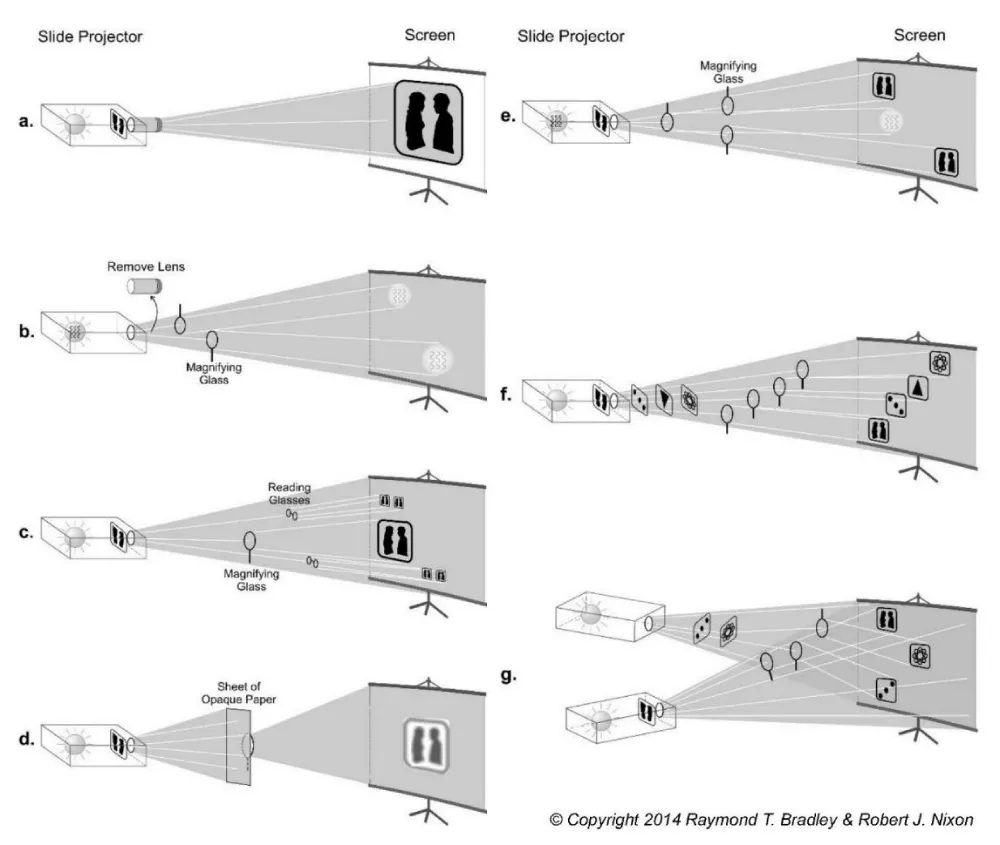
Figure 4: Demonstration of a Holographic Effect. The normal setup for a slide projector (a) is shown first, with the image of a slide projected by the light emitted from the light bulb through (and focused by) the lens onto the screen. In (b) both the lens and the slide are removed, so that a cone of empty ‘white’ light is projected onto the screen—'empty,’ in that no image of anything at all is apparent. However, holding a magnifying glass perpendicular and close to the projector, at the right focal length, reveals an image of the light bulb’s filaments, wherever the magnifying glass is held in the plane of the light cone field projected into the screen. In short, the features of a source object (in this case the light bulb) are encoded as an image everywhere in the energy field emitted from that object. In (c) the slide is reinserted, but without the lens, so that the light passing through the slide appears on the screen as ‘white’ light; no features or image of the slide are visible. However, holding a magnifying glass and/or one or more pairs of reading glasses (each is a lens), an image of the whole slide can be retrieved for each lens, at the appropriate focal length, from anywhere within the cone field of the ‘white’ light—demonstrating that an image of the slide is encoded into the light’s energy field. Covering most (~90 - 95%) of the magnifying glass lens with a sheet of paper, as shown in (d), the slide’s image can still be retrieved from any position in the light cone field—demonstrating the property of information redundancy. The image’s features are fuzzy, due to the reduced energy density storage capacity producing a loss in resolution. Yet the object as a whole is still discernible from the smaller amount of light energy passing through the tiny portion of the magnifying glass’ lens not covered by the sheet of paper. In (e), an image of the light bulb’s filaments and that of the slide can both be retrieved, at appropriate focal lengths, anywhere in the light field on the screen. This shows that the encoded information from the source object is preserved, even though the energy field from the light bulb has passed through the slide and encoded the slide’s features as well. This principle of superposition—the recording and preservation of the features of all objects encountered by energy field emitted by an object—can be seen more dramatically in both (f) and (g). In (f), the images from multiple objects (in this case a stack four different slides ~1” apart) are simultaneously enfolded into the light field of energy, so that a clear image of all of the features of each object as a whole is retrievable from any position in the ‘empty’ field of white light by holding one or more magnifying glasses at the appropriate focal length/s. Preservation of object/image integrity over multi-field interactions is illustrated in (g), using two slide projectors. When the light fields from two projectors, passing through different slides (a stack of two slides in the top projector and one slide in the other), are simultaneously projected, so that their light fields overlap as they travel to the screen, a clear image of the features of the object depicted in each of the slides is retrievable from any position in the overlapping light cones. By holding a lens (magnifying glass or reading glasses) at the appropriate focal length, the images of all objects in the slides can be retrieved—either separately, using a single lens, or simultaneously, with multiple lens at the appropriate focal length/s. While not shown, an image of the source object (the light bulb’s filaments) can also be retrieved, despite the light’s journey through all of those objects on its path to the screen. Finally, the same experiment can be repeated with a movie projector, in which each picture frame in the movie film is analogous (but not equivalent) to a quantized unit of information—a logon—in quantum holography, as described below. (© Copyright 2014, Raymond T. Bradley & Robert J. Nixon, Center for Advanced Research; reproduced with permission.)
The discussion involves two distinct realms—spacetime reality and the spectral domain—which are related, in that Gabor showed you can get from one to the other and back by means of a Fourier transform (FT) function, which means it is invertible [6]. Thus, a Forward FT (F(k)) into the spectral domain, and an Inverse FT (f(x)) back to spacetime10. At this point, no specifically quantum claim is required. The Fourier transform is invoked here as the formal mapping between the spacetime representation and spectral representation. As we will see, the quantum issue enters only when, following Gabor, time and frequency are treated as conjugate variables subject to his minimum uncertainty relation, thereby defining an elementary unit of information (a quantum) in joint time-frequency space. In short, although seemingly paradoxical, mutually exclusive domains, spacetime and the spectral domain are complementary: viz, while each embodies a different face of reality, they are unified by a specific physical mechanism of translation—the Fourier transform function.
_____________________________________________________________________________________
A further distinction is needed. In what follows, holography is used in two related but different senses. In one sense, it refers to an experimentally grounded physical and signal-processing framework involving interference, spectral encoding, and transform relations. In the other, in a later section, it refers to a model for neural and psychosocial organization. In the latter case, the claim is not that social systems literally perform optical holography, but that they may exhibit distributed, nonlocal forms of informational organization analogous to those found in holographic processing.
These same dimensions, spacetime and frequency, are also the basis of Quantum Holography. Except here, drawing on the mathematics of Heisenberg’s principle of uncertainty11, Gabor [7] treats the two as orthogonal coordinates in which measurement precision on one ordinate is obtained at the cost of total uncertainty on the other. However, when conjoined, as conjugate variables, the coordinates create a phase space in which minimum values on both can be mathematically determined (Figure 5A). The phase space is Gabor’s elementary unit of information, a quantum of information—the logon, which defines the minimum amounts of energy, frequency and space/time required to encode a feature element of a signal for communication with fidelity. Since certainty can be obtained only by minimizing uncertainty on both ordinates, the minimum measurement of the signal in time and frequency is given by Dt Df = ½, which defines an elementary unit of information—approximately half a cycle [7]12. More precisely, the logon is not merely a metaphorical snapshot. It is Gabor’s minimum jointly bounded time-frequency unit for representing a signal feature with finite fidelity. Thus, the term “snapshot” is employed, both by Pribram and me, only as an aid to understanding.
_______________________________________________________________________________________________
In Gabor’s mathematics, the phase space is Gaussian modulated (“windowed”/ constrained) to prevent spectral progression to infinity. Gabor’s reasons for using a Gaussian envelope to modulate the elementary signal are given in his paper, “Communication Theory and Physics” [22]:
One can represent an arbitrary signal in an infinity of ways as a linear function of certain “elementary” signals, associated with the individual cells. There is however one description of particular interest, in which the elementary signals are harmonic functions, modulated with a “Gaussian” signal [,] i.e. they have envelopes of probability shape. These share with other functions the property that their Fourier transforms have the same shape, but they are unique in the respect that the product of their “effective” duration and of their effective frequency width is the smallest possible for any function [22].
Viewed in three dimensions, the logon has a sinusoidal form which emerges from its cosine and sine components (Figure 5B). Communicated as a succession of quantized ‘snapshots,’ logons overlap (Figure 5C). The overlap means there is spectral enfoldment of information among adjoining logons, creating, in Gabor’s words, an “overlap of the future” [7], an important property we’ll come back to. Finally (Figure 5D), the logon is shown as a ‘cell’ in Gabor’s “Information Diagram”, which is the basis of his “expansion” method for measuring/capturing the “entire signal” for communication13. The pattern of shading shown in the figure, diagonally across the cellular matrix, represents the ‘peaks’ and ‘troughs’ morphology of waves of energy. Signal fidelity in communication requires millions of logons (each cell in the information diagram matrix = a single logon, a quantum of information). Elsewhere [22], Gabor calculates the amount of energy required for each logon—viz, the minimum energy required for transmission of a single unit of information—which he determines to be “about a hundred million photons per information cell in order to define amplitude and phase of the signal to 1% each [!]” As if he was anticipating Pribram’s work, Gabor concludes, “The interesting feature of this result is its generality, it applies to the unknown processes in the nervous system as well as to electrical communications” [22].
______________________________________________________________________________________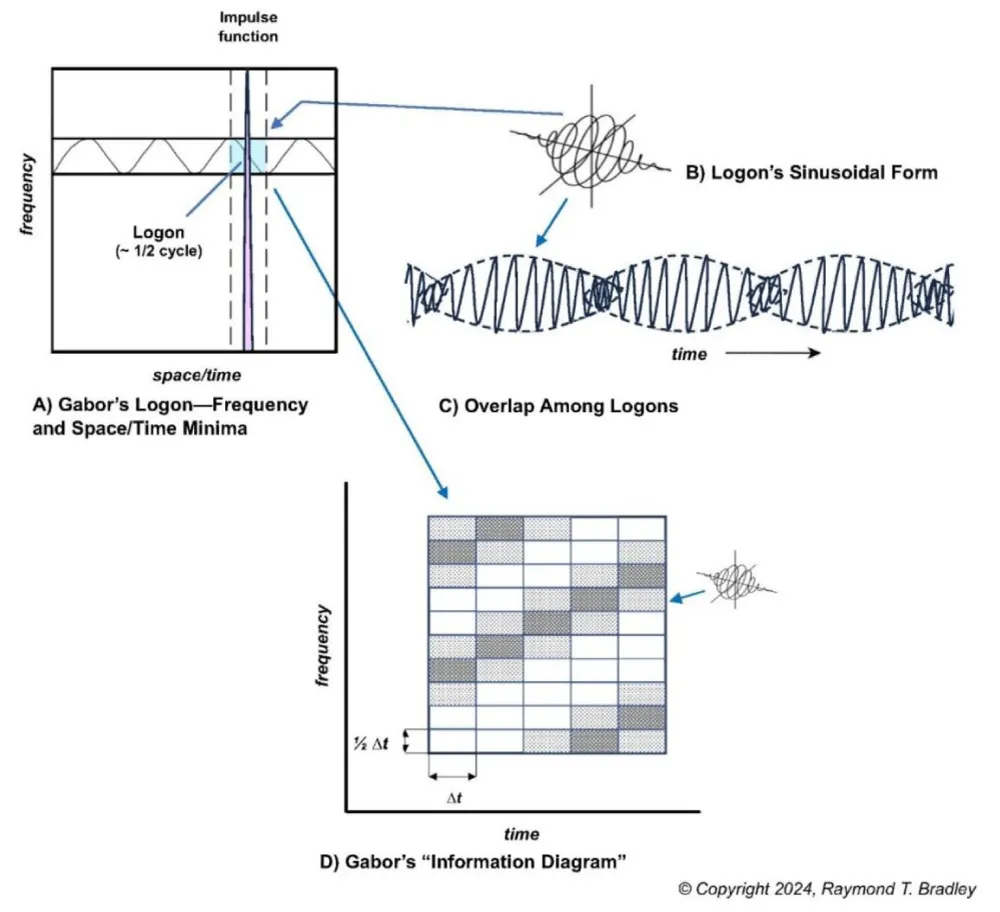
Figure 5: Basic Features of Gabor’s Elementary Unit of Information—the Logon A) The minimum amounts of frequency and space/time (shaded rectangle) required to encode a signal, which Gabor called a logon. B) The logon’s 3-dimensional sinusoidal form which emerges from the real (cosine) and imagined (sine) components of the complex Gabor waveform—Gaussian modulated (Adapted from MacLennan [36](1994, Figure 10, p. 11) and used with permission). C) The “overlap” of logons wherein the information from a given logon is spectrally enfolded into adjacent logons. D) Gabor’s “Information Diagram” per his “expansion” method for grouping ensembles of logons to capture the entire signal [7]. The pattern of shading, diagonally across the cellular matrix, represents the ‘peaks’ and ‘troughs’ morphology of waves of energy. (From Bradley [20](2024a, Figure 2; © copyright, R.T. Bradley 2024; reproduced with permission.)
This is how Pribram explains it:
Gabor’s mathematical formulation [of the elementary function] consisted of what we now call a “windowed” [Gaussian modulated] Fourier transform, that is, a “snapshot” [the logon] (mathematically defined as a Hilbert space) of the [frequency] spectrum created by the Fourier transform which otherwise would extend spectral analysis to infinity. … The Gabor function provides the means to place these communication patterns within coordinates where the spectrum is represented on one axis and space-time on the other. The Fourier transform lets us look at either space-time or spectrum; the Gabor function provides us with the ability to analyze a communication within a context of both space-time and spectrum [4].
Accordingly, the term quantum holography is used here in a restricted sense. It refers to Gabor’s quantized information formalism grounded in minimum uncertainty relations. It does not imply that every neural or psychosocial process discussed below is itself a quantum event in the strong physical sense. Where ordinary transform relations and receptive-field filtering suffice, the explanatory basis remains signal processing.
With these distinctions in place, the next question is how such signal-processing principles are instantiated in neural tissue.
Receptive fields in the neural substrate
The features of the objects of perception are encoded in the interference of oscillations of energy as tacit information (spectra) and processed by the neural substrate in receptive fields composed of densely interconnected networks of dendritic fibers [8] (Figure 6A). In various experiments, Pribram and his collaborators found that neural response spectra in receptive fields could be “systematically described,” in graphic form, as three-dimensional manifolds rendered by plotting spatial frequency against temporal frequency (Figure 6B). Importantly,
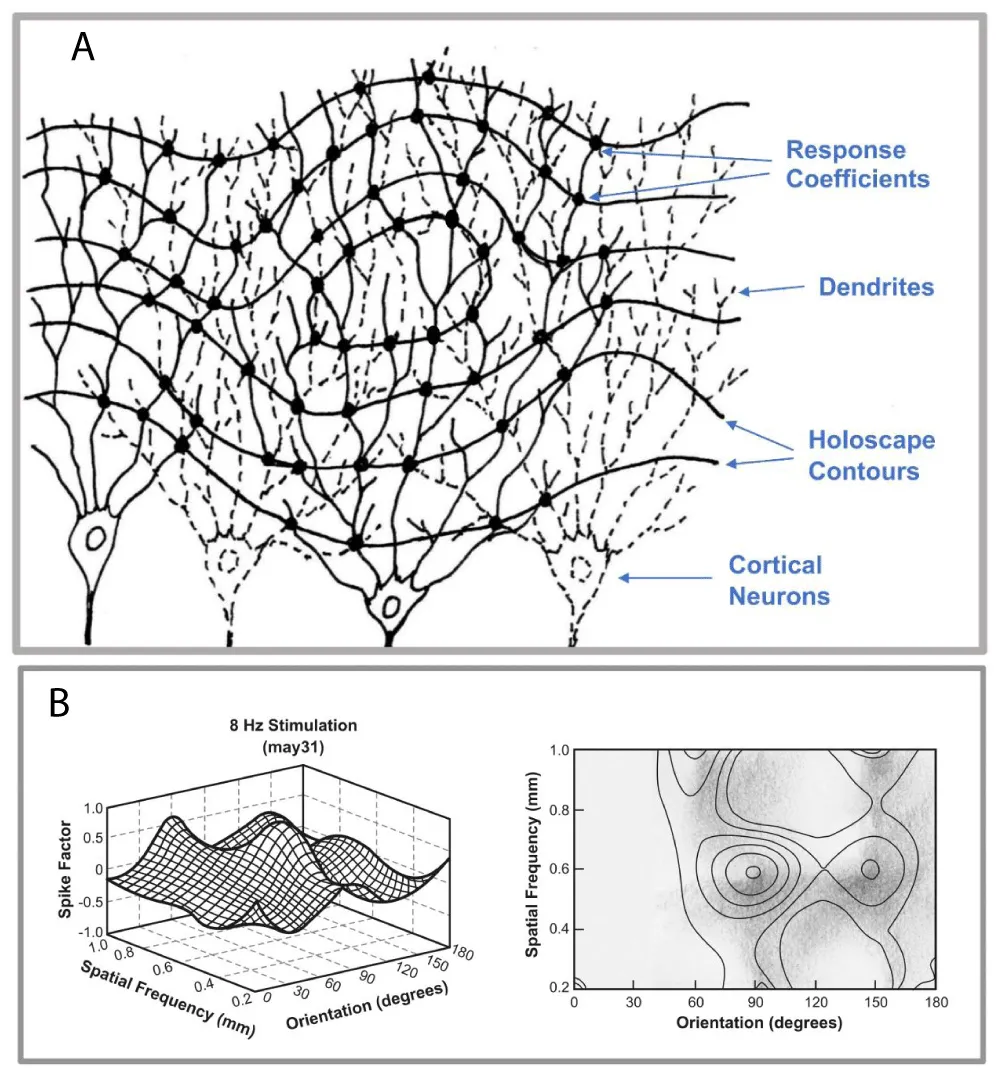
Figure 6: A: Neural Microstructure: Pribram’s “Idealized Portrait of a Holoscape”. B: Three-Dimensional Response Manifold and Associated Contour Map (‘Holoscape’) of the Barrel Cortex in Rats. A) Pribram’s “Idealized Portrait of a Holoscape,” shows overlapping dendritic receptive fields in which response coefficients of identical value are plotted as a series of contour lines which increase in value toward the center, to create a three-dimensional, knoll-like form. B) Pribram and his collaborators found a similar morphology in the response field in the barrel cortex of rats in an experiment stimulating the rat’s whiskers in different orientations and spatial directions. Of note, is that the response manifold displays sinusoidal Gabor wavelet-like form—left. The term “holoscape” is used in Pribram’s sense to denote the organized response topography generated across overlapping receptive fields. It refers to a manifold of response coefficients, often displayed as contours or as a knoll-like three-dimensional form, and not to a separate ontological domain. (Both figures adapted and redrawn from Pribram [4]; reproduced with permission from Bradley, 2024a; © copyright, R. T. Bradley.)
It was then demonstrated that these manifolds could be derived from Gabor-like functions, indicating that somatosensory processing is consistent with the physics of conventional signal processing theory14.
____________________________________________________________________________________The conjoint operation of adjoining receptive fields creates ensembles of logons, each of which is an element of a feature processing channel and for which the limits of information processing fidelity are set by Gabor’s principle of minimum of uncertainty. Essentially, the operation of ensembles of logons occurs in the same terms as Gabor describes in his expansion of an “arbitrary signal in cosine-type and sine-type elementary signals” [7] (Figure 5D).
Neural processing over these adjoining receptive fields creates a “transneuronal manifold” which Pribram visualizes as a “holoscape” (Figure 6A) embodying Fourier coefficients (amplitude, frequency, and phase). Together, the coefficients define the relations between oscillations, and therefore spectrally encode the stimulus object’s spacetime features in physical form. “These components are quantified as Fourier coefficients. The ensemble of such coefficients, when embodied in physical form, becomes palpable as an optical hologram” (Figure 6B) [8].
Processing in the neural microstructure requires a “constraint” to prevent spectral progression to infinity and thus enable translation of the spectrally encoded data into imagery along spacetime coordinates:
Note that we are dealing with dendritic patches limited to one or a small congregation of receptive fields … [so that] the transformation is limited to a single or small patch of receptive fields. By definition, therefore, the Fourier transformation is constrained, windowed, making the transformed brain event a [Gabor] wavelet [4].
This is a crucial point, for without the operation of a constraint “window” on the neural processing of spectra, there would be no physical means by which the energetically encoded information from objects could be rendered into imagery along spacetime coordinates. In other words, we would be blind—unable to perceive the spacetime features of an object—because our perceptual experience would be confined solely to the spectral domain, as David Bohm points out [25].
Pribram goes on, “Wavelets are not instantaneous numbers. As their name implies [,] wavelets have an onset slope and an offset slope. Think of a musical tone: you know a little something about where it comes from and a little as to where it is leading” [4]. In addition to the onset and offset slope of the wavelet, there is an overlap among successive wavelets as logons. This suggests a basis for anticipatory aspects of sensory processing, insofar as the overlap among successive wavelets carries structured information across adjacent intervals. It arises from “interference” in the overlap among logons, which reflects their spectral enfoldment and which as a Fourier series extends to infinity (Figure 5C). In Gabor’s words:
Though the overlapping of the elementary signals may be of small practical consequence …, we have seen that we could not carry out the expansion into elementary signals without taking into consideration also the “overlap of the future” [7].
Adjustable neural ‘lens’
In his final book, The Form Within [4], Pribram clarifies that Gabor information processing and Fourier image processing are both involved in neural processing. Also, the ‘constraints’ on processing in the microstructure substrate of receptive fields are affected by “cognitive influences”, and that the prefrontal cortex (which processes decision and emotional regulation) is implicated in the change to Fourier processing:
The form of receptive fields is not static. …receptive field properties are subject to top-down (cognitive) influences from higher-order brain systems. Electrical stimulation of the inferior temporal cortex changes the form of the receptive fields to enhance Gabor information processing, as it occurs in communication processing systems. By contrast, electrical stimulation of the prefrontal cortex [decision and emotional regulation] changes the form of the receptive fields to enhance Fourier image processing …. The changes are brought about by altering the width of the inhibitory surround of the receptive fields. Thus, both Gabor and Fourier processes are achieved, depending on whether communication and computation or imaging and correlations [respectively] are being addressed [4].
This is vitally important, for it means that the constraint “window” can be adjusted, much like a lens, to enhance signal processing via the inferior temporal cortex (Gabor processes) or modulated under top-down cognitive influence, by way of the prefrontal cortex, to enhance image processing (Fourier processes)—a key point we will come back to. While a more complex, nuanced process in reality, the logic of these operations in the neural microstructure is shown in Figure 7.
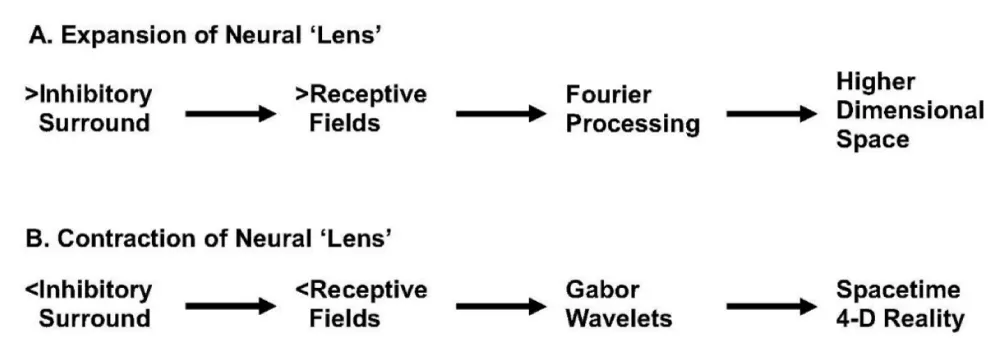
Figure 7: Adjustment of Neural ‘Lens’.
Purposeful change: Holographic feed forward processes
What follows is a theoretical extension of Pribram’s framework to purposeful action. Armed with the principles of holographic processing and their application to neural processing, and drawing on earlier work [27,28], the processes of purposeful action can be described in the terms of the two kinds of holography. Not only does this fit with Pribram’s research, but holographic processing has enormous efficiencies (Figure 4) which arise from the spectral nature of the processing entailed (see the blue shaded boxes in Figure 8). While space constraints permit only a highly condensed overview, I have compensated with a more detailed depiction of the processing logic and description of processing at each phase of the process in Figure 8.
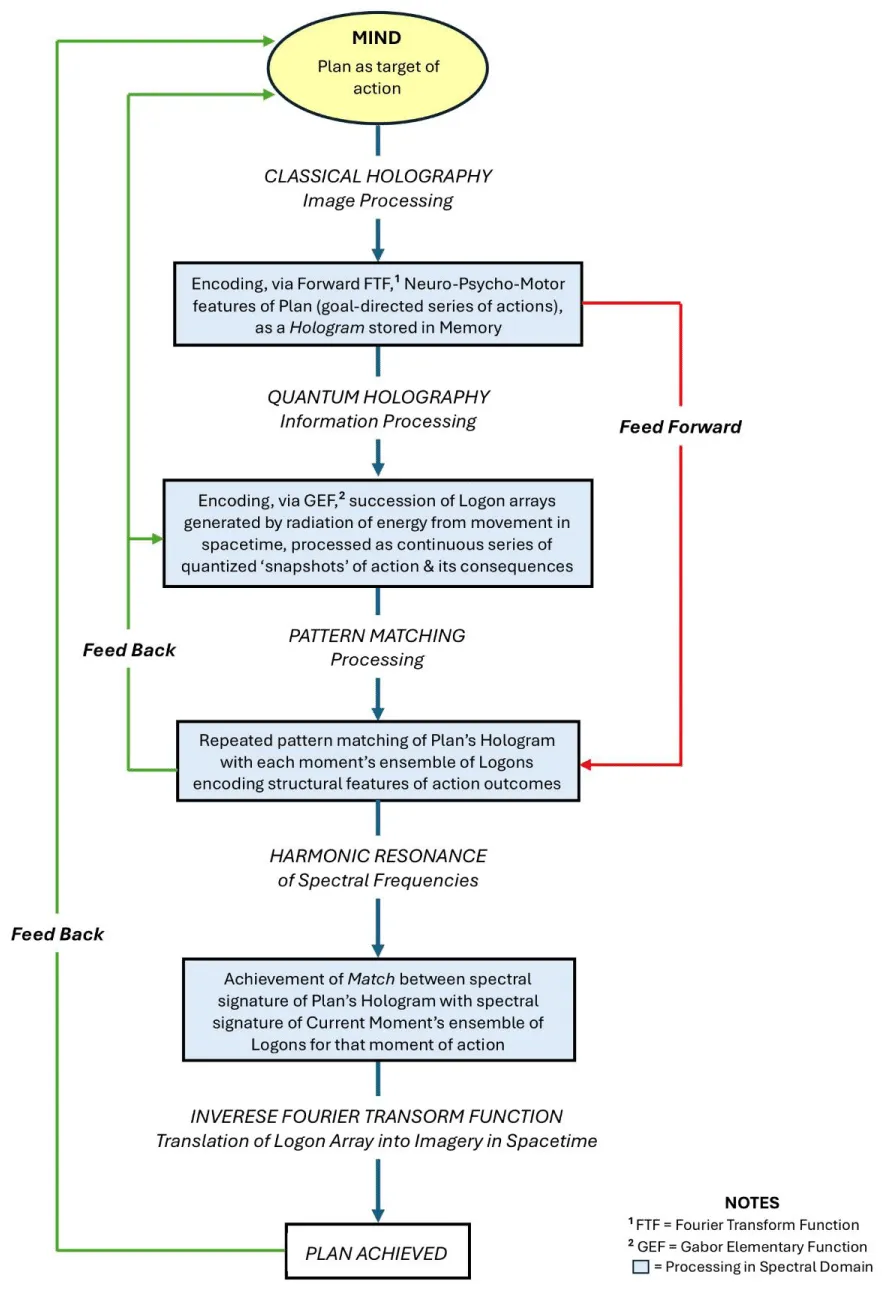
Figure 8: Holographic Processing of Purposeful Action. (Adapted and redrawn from Bradley, 2004, Figure 4.8, © copyright, 2026, R.T. Bradley; reproduced with permission [29])
Returning to Pribram’s notion of a Plan as a neurological “image of achievement”, for the individual, a Plan is the means of achievement: a mentally constructed target object to which the consequences of a program of action are directed, and against which the results of actions are compared [8]. There are two key elements here. One is the Plan, which, to be effective, has to be stable, viz, visualized in the Mind as an object of constancy. The second element involves actions and their consequences which, by nature, are dynamic and changeable.
Thus, because Classical Holography records an image of an object that is static, it is the neuro-psycho-energetic processing means by which a mental Plan is encoded as a hologram and stored in memory as stable representation. By contrast, because Quantum Holography encodes, in ensembles of logons, the structural features of object movement in spacetime as a continuous succession of quantized ‘snapshots’ (like the individual frames in a video/movie), it is the neuro-psycho-energetic means by which movement (behavior and its consequences) is encoded and perceived by sensory perceptual systems.
Putting the two together in a pattern matching process, in which the hologram of the Plan is the reference image against which each moment’s quantized ‘snapshot’ of that moment’s movement in spacetime is compared, the process repeats until a match in spectral signatures of the two is achieved. The match signals that the individual’s action at that moment has achieved the Plan.
Summary
Perceptual input from sensory experience is encoded, via a holographic process, in the interference spectra of oscillations of energy and processed by adjoining receptive fields in the neural substrate, which are constrained by an inhibitory surround. Essentially, these microprocessing patterns (Pribram’s “holoscape”) consist of ensembles of logons, each of which is a feature processing channel. The constraint window on neural processing in the micro substrate of receptive fields is adjustable and can be willfully changed—expanded to enhance Fourier processing; contracted to enhance Gabor processing. This provides the conscious means for changing the brain’s ‘lens’ in the neural substrate—viz, to focus attention to the 4-D existential world of spacetime, shift focus to the spectral domain of Fourier processes Finally, purposeful action can be understood as a holographic pattern-matching process, in which the hologram of the Plan is the reference image against which each moment’s quantized ‘snapshot’ of that moment’s movement in spacetime is compared until a match in spectral signatures of the two is achieved.
Information processing in psychosocial systems
A word of caution is needed before proceeding. The argument in this section is not that social systems literally instantiate optical holography, but that their organization may be modeled using distributed informational relations analogous to those found in holographic processing.
My own journey of scientific discovery also began with a paradox. As a graduate student at Columbia University, New York, in the mid-1970’s, I participated in a largescale, longitudinal study of 60 urban communes—10 selected from six major metropolitan areas in the US (Atlanta, Boston, Houston, Los Angeles, Minneapolis-Saint Paul, and New York) [29]. The primary focus of the study was to map the structure of social relations, on a number of different relational ‘contents’, among all adult members (> 15 years old) in each group for the three waves of data collection (1974 - 1976) of the study. We developed a “Relationship Questionnaire” to measure each individual’s perceptions of their relations with each member of the group, as a set of discrete dyads [29-31].
Of the 46 communes from which ‘usable’ relational data were collected, my analysis revealed, in a dramatic way for “power” relations in some groups, a paradox of measurement when sociograms were constructed from relational data of dyadic perceptions (Figure 9A)15. From the data collected about perceptions of parts—dyadic relations—an image of the organization of the whole—group’s social structure—was obtained. This suggested that group structure—collective consciousness—was organized in a holographic-like manner in which information about group order was encoded and distributed throughout a field of collective ‘energy’ to all members. In a ‘crude’ test of this ‘holographic’ hypothesis, I used membership turnover as a bio-psycho-social mechanism that could disrupt the perpetuation of group order through time. Insofar as, empirically, this was ‘true’, it would constitute evidence against the hypothesis of holographic social order. But what I found is that coherent collective order persisted despite high levels (>150% in a year) of membership turnover:
___________________________________________________________________________________Using membership turnover as analogous to the removal of cortical tissue in experiments on brain function [and memory], [I] found that a commune’s ability to maintain a coherent order of power over time is not affected by the aggregate level of turnover or a change of (sociometric) leader/s (Bradley, 1987: 269; italics added).
Moreover, a coherent image of such group order appeared to be associated with group survival (Figure 9B). Further investigation, using triadic analysis of the relational structure of charismatic16 and noncharismatic communes, revealed that the triadic17 profiles of “Loving” and “Power” relations differentiated the two systems. Finally, the difference in triadic profiles of Surviving and Non-surviving groups appeared strongly interconnected as a balanced coupling directly associated with future survival (Figure 9C). Pondering these findings, Pribram and I collaborated on a series of works18 in an effort to explain the endogenous processes involved.
______________________________________________________________________________________
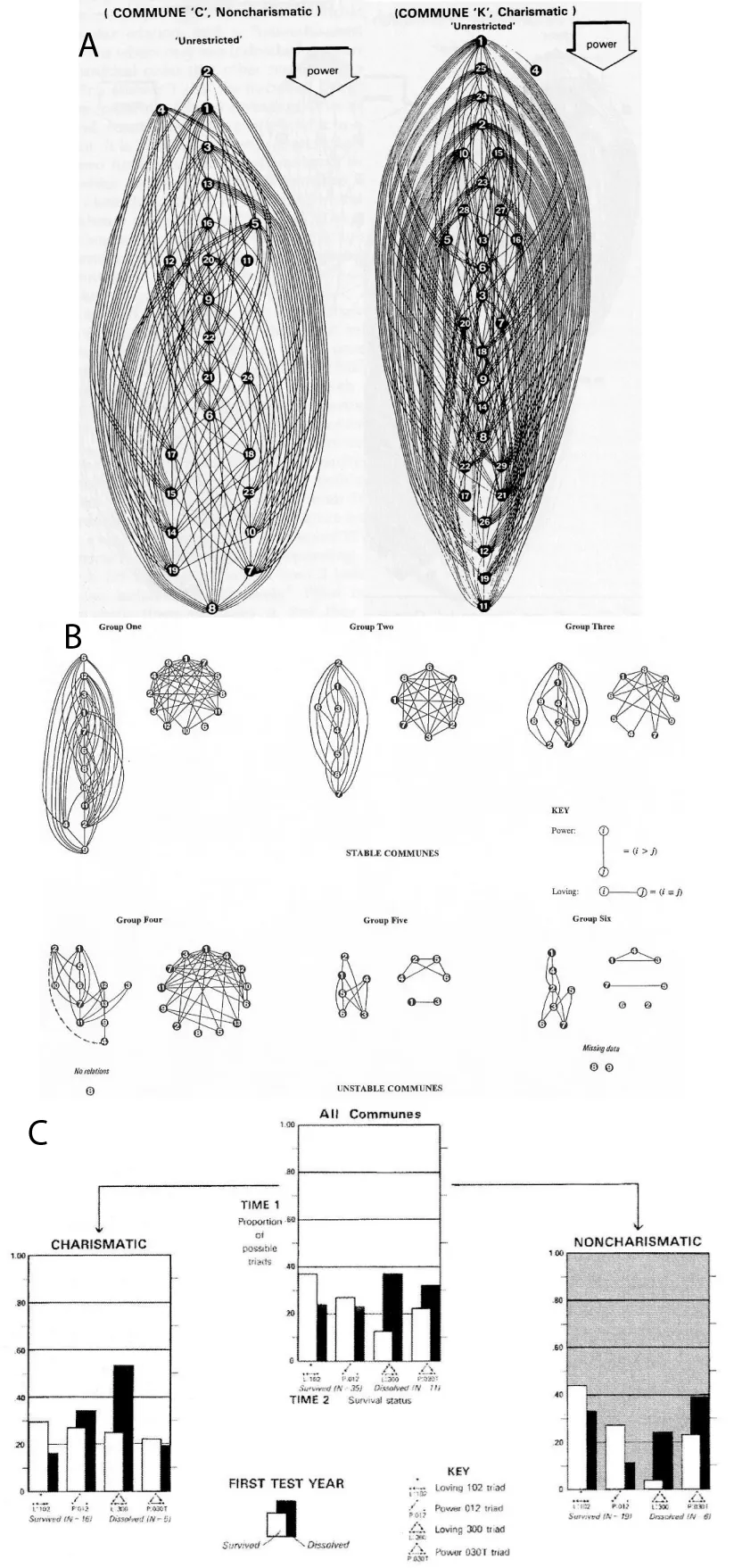
Figure 9: A: Sociograms of Dyadic Perceptions “Power” Relations in a Non-charismatic and a Charismatic Commune. In the sociograms, individual members are represented by the black dots (the numerical digits are unique codes to identify each group member) and the lines connecting pairs of black dots relations. In Commune C (left), there are 24 members interconnected in a transitively hierarchy of “Power” relations with 15 distinct levels; in Commune K, comprised of 29 members, there are 21 distinct levels! The reader is reminded that this ‘emergent’ order of a coherent structure (no cycles, conflicts, or isolated cliques) is constructed from perceptions of discrete dyads; no mention of “group structure” was made in the Relationships Questionnaire [28,31](see Bradley & Pribram, 1998, Table 2, page 38, or Bradley, 1987, Appendix B, page 329). (Source: Bradley, 1987, Figures 8.1 and 8.2, respectively, © 1987 R. T. Bradley; reproduced with permission [28,31].) B: Examples of the Structure of “Loving” and “Power” Relations in Six Communes (Time 1), by Survival Status 12 Months Later. (Source: Bradley & Pribram, 1998, Figure 1, © 1996 R. T. Bradley; reproduced with permission [31]). C: Triadic Structure of “Loving” and “Power” Relations for Charismatic and Noncharismatic Communes at Time 1 by Survival Status 12 Months Later. (Adapted from Bradley, 1987, Figs. 7.4 and 7.5, (c) R. T. Bradley, 1987; used with permission.)
The result was a Theory of Social Communication that draws on the principles of energy conservation and self-organization and Gabor’s [7] concept of information—minimum of uncertainty—to describe how the moment-by-moment processing of information generates stable, effective forms of collective organization [31]. Here, too, the term quantum holographic is used by analogy to Gabor’s quantized information formalism and not as a claim that social communication is literally an optical or quantum-mechanical process. There is space for the briefest summary.
Theory
Translating Gabor’s ordinates of energy frequency and space/time constraint to the dimensions of affective energy and social control, respectively, in social systems, we began with the supposition that the principles of quantum holography could elucidate the energy-based processes of communication and action in collectives. In what follows, activation of bio-affective energy is Flux, and implementation of social constraint on members’ potential action is Control. The primary proposition is that stable collective organization is a function of the degree of interconnectedness between the two as a balanced coupling.
Energy is a measure of the means, the fuel, for maintaining organization in the face of challenge (novelty) or changing order in the face of inertia. Energy is also the medium for information processing, the medium for encoding and relaying communication among the elements of a system.
Collective organization entails a mutually beneficial relationship of collaboration—of individuals working together in pursuit of a shared purpose. To collaborate entails work (as physical behavior and interaction), and work requires a supply of biological energy, which is provided by the individuals as they expend their energy in interacting and activity toward a common outcome.
Membership establishes a bond of affective attachment19, which the group activates to mobilize each individual’s biological propensity for action—viz, the potential for expending energy. Collaboration also requires social constraint: that each individual’s expenditure of energy in action be regulated, coordinated, and directed toward the group’s objective, and not be dissipated in other useless activity.
___________________________________________________________________________________The collaborations within the group that form the communication system are formed by the interpenetration of relations among members organized along two dimensions, in which the values allocated in each dimension define points in a socioaffective field (Figure 10B). The values on the horizontal dimension represent Flux, the amount of activation of bio-affective energy (potential energy) in the group. This field is the energetic medium through which transmission of all interactions within the group occurs. It provides the ontological means by which members sense and ‘read’ each other’s actions.
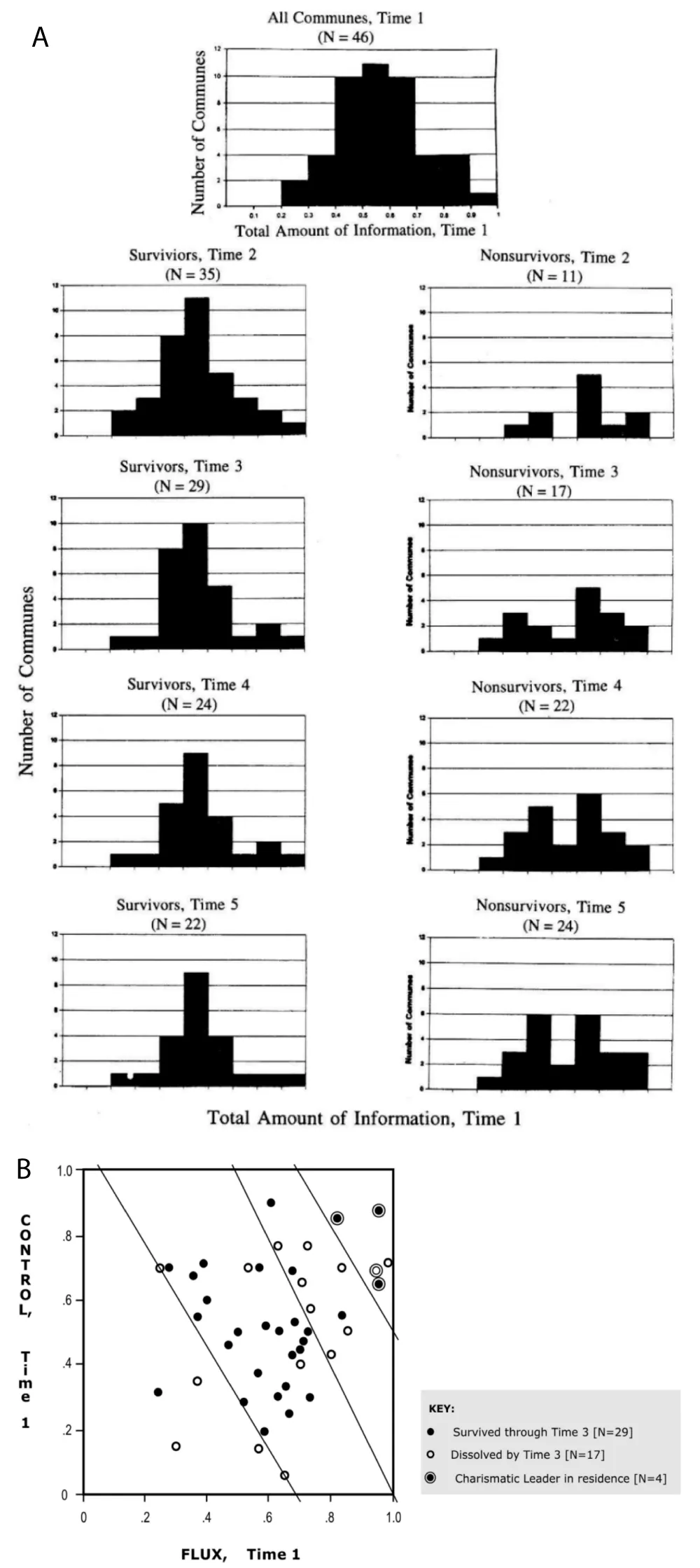
Figure 10: A: Bar Charts of a Time Series Distribution of Communes on Total Amount of Information (Time 1), by Survival Status (Time 2 through Time 5). (Source: Bradley & Pribram, 1998, Figure 5, © 1996 R. T. Bradley; reproduced with permission [31]). B: Scatter Plot of Flux and Control at Time 1, by Survival Status 24 Months later. The three diagonal lines mark the thresholds of four alternating bands of Surviving and Non-surviving communes oriented along the main diagonal. To perform statistical analysis, groups above the second line were aggregated into one category—Nonoptimal, Upper Region (N = 15, 33%). A second category—Optimal, Mid Region, was constructed of the groups between the bottom two lines (N = 25, 54%). The third category were groups below the bottom line—Nonoptimal, Lower Region (N = 6, 13%). (Source: adapted from Bradley and Pribram (1998) Figure 7, © 1996 R. T. Bradley; reproduced with permission [31])
The values on the vertical dimension represent the amount of Control, the degree to which each member’s behavior is regulated by an ordered network of hierarchical constraints exercised at that location. By differentially constraining the paths by which individuals expend their energy, both with respect to specific locations in space and with respect to particular moments in time, the hierarchy of controls in-form—viz, give shape to [35] the organization of collective action. Thus, the interaction between flux and control operates as a communication system that generates and distributes units of information throughout the collective.
Because the units are energetic, in that information is enfolded in the movement of affective energy within the collective, Pribram and I use Gabor’s [7] concept of information to describe them. It is expected, therefore, that the operation of hierarchical Controls on the relations of affective energy generates information as a moment-by-moment description of the collective’s internal organization, encoded in terms of both structure (spatial-temporal position) and Flux (distribution of energy). The succession of descriptions within space-time and spectral coordinates is in terms of ensembles of logon-like units of information. These are enfolded into the field of affective attachment and communicated throughout the collective, via a holographic-like process, to all group members, thereby giving shape to the collective’s organization on a moment-by-moment basis. Thus, the information exchange that characterizes communication can be described as quantized. In short, the interaction between a network of affective bonds and a hierarchy of social controls operates as a quantum-holographic-like information processing system that informs the transformation of potential energy into a stable order of effective collective work.
However, there are limits on the amount of information generated by flux and control that can be processed efficiently. Amounts that fall outside the limits–amounts that either exceed the communicative processing capacity, or amounts that are insufficient to inform the collaborative activation and expenditure of energy–increase the likelihood of endogenous disorganization and result in collective dysfunction and instability.
Functional (and thus stable) organization requires a certain minimum amount of energy, and also that a minimum of direction be given to the expenditure of that energy. If these minimum values for communication are not met, dysfunction results and non-viable or unstable states of order are created. Beyond the threshold of these minima, the range of low values for stable organization narrows progressively from many different loosely coupled combinations of flux and control to a close complementary coupling involving high values of both. Finally, in terms of Figure 11, there is a discontinuity (a jump) in the values defining functional organization, giving rise to a pattern of extremely high values that create the potential for system transformation. When energy activation is maximized, stability is problematic and requires an equivalent level of control–a tight, one-to-one coupling between flux and control.
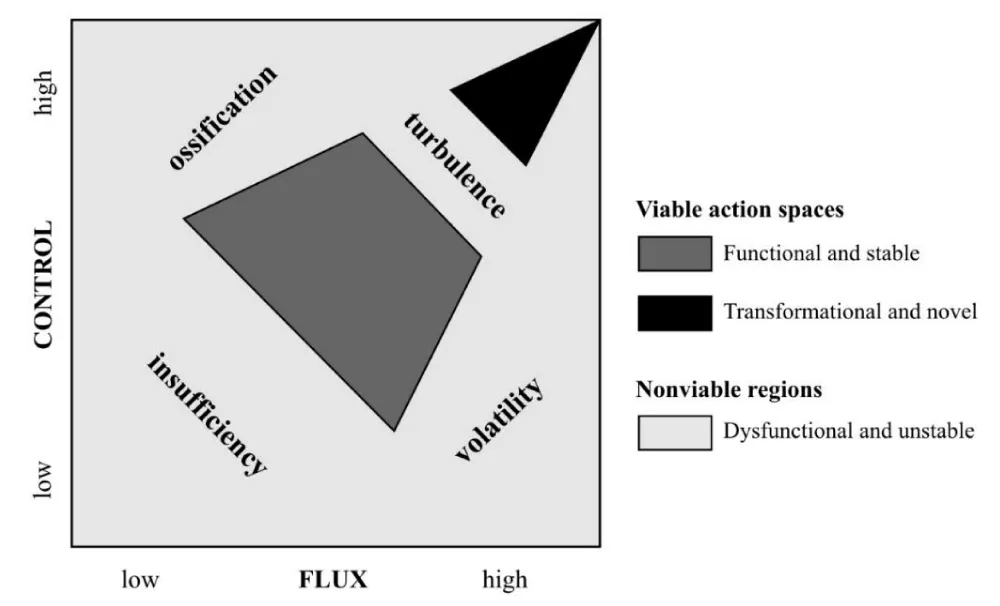
Figure 11: Model of Communication and Action States of Collective Organization. The model was based on an interpretation of the results of the various statistical analyses and abstracted into two generalized regions of Viable Action Spaces and Nonviable Regions, and then further delineated into subregions by coordinate values on Flux and Control. (Source: redrawn from Bradley and Pribram [31] Figure 11, © 2004 R. T. Bradley; reproduced with permission.)
Evidence
Of the extensive analyses we conducted, two, in particular, provide compelling evidence of the utility of our holographic approach. The first was an analysis of the information processing capacity in relation to group survival. A measure of the Total Amount of Information processed by a collective at a given moment in time was computed by summing and averaging for each group the incidence Flux and Control triads at Time 1. The values for all groups were then grouped into 0.10 intervals and, holding these values on this measure constant at Time 1, the sample was partitioned by Survival Status with the distribution of Survivors and Non-survivors plotted on a time series of bar charts at 12-month intervals—viz, from Time 2 through Time 5 (Figure 10A).
In terms of results, two patterns stand out. One is the ‘bell-shaped’ curve for “All Communes” at Time 1 at the top; 67% of the groups fall within one standard deviation of either side of the mean (0.569). The second is that this bell-shaped distribution devolves over time into two contrasting patterns that are virtually the inverse of each other by Time 5: a ‘single-peaked’ distribution for the 22 Survivors with its mode in the 0.500 – 0.599 interval; a bi-modal distribution for the 24 Non-survivors with its ‘trough’ in this same interval. The difference in survival rates between the two groups on the 0.500 – 0.599 interval and those groups outside this range is statistically significant (chi-square = 6.695, p = 0.010). Taken together, the two patterns appear to mark the bounds of a region where the probability of stability is maximised. Thus, it would appear that the amount of information in the intervals above 0.599 was excessive in terms of processing capacity, whereas in the intervals below 0.500 it was insufficient to sustain a viable collective.
The second analysis began with a Scatter Plot of the groups in the coordinate system formed their values on Flux and Control at Time 1, with Survival Status 24 months later indicated by a black dot for Survivors (N = 29, 63%), and a hollow dot for Non-survivors (N = 17, 37%) (Figure 10B). A triangular pattern of the distribution of groups, oriented along the main diagonal of Flux and Control, is evident. The three diagonal lines mark the thresholds of four alternating bands of Surviving and Non-surviving communes. To perform statistical analysis, groups above the second line were aggregated into one category—Nonoptimal, Upper Region (N = 15, 33%). A second category—Optimal, Mid Region, was constructed for the groups between the bottom two lines (N = 25, 54%). The third category was groups below the bottom line—Nonoptimal, Lower Region (N = 6, 13%). The differences in the rates of instability, by Time 3—24 months later, between the three groupings are statistically significant (chi-square = 15.641, p = 0.0004).
Since it was possible that other sociological variables [29] may statistically explain the three survival groupings, identified by Flux and Control, Discriminant Function Analysis was conducted to rule these factors out and confirm the veracity of the results above. Along with Flux and Control, eight sociological variables20 with limited missing data were used as independent variables for the stepwise multivariate analysis. Table A, in the Appendix, presents the results of this analysis.
___________________________________________________________________________________Of the ten variables analyzed in the stepwise procedure, only two—Flux and Control—had sufficient statistical power to meet the minimum for entry (F-statistic = 0.50). Flux entered at Step 1 and Control at Step 2 (Wilks’ Lambda coefficient = 0.517, p < 0.0000, and 0.214, p < 0.0000, respectively). The ‘Test of Difference’ between all four pairs of groupings of the three Optimality categories was highly statistically significant (F-statistics ranged from 14.246 to 64.451, p < 0.0000 for all pairs of groupings). While two discriminant functions were constructed, Canonical analysis revealed that Function 1 had, by far, most of the discrimination power (Squared Canonical Correlation = 0.786, Percent of Variance explained = 99.99%, Eigenvalue = 3.674). Together, the two Discriminant Function constructed from Flux and Control were able to correctly classify 44 (96%) of the 46 communes into their correct Optimality category. Prediction rates for the three categories were: 25/25 (100%) groups for the Optimal-Mid Region category, 14/15 (93%) for the Nonoptimal-High Region, and 5/6 (83%) communes in the Nonoptimal-Low Region. These prediction rates were substantially higher than the prior probabilities (0.54, 0.33, and 0.13, respectively).
Overall, taken together, these results provide a compelling empirical basis for the Model of Communication and its relation to collective action presented in Figure 11. These findings do not by themselves prove holographic processing in a literal physical sense; rather, they indicate that the proposed framework captures a nontrivial and predictive structure in the data.
Summary
The theory postulates that social constraints (Control) over the activation and distribution of affective energy (Flux) result in social communication by way of quantized (logon-like) units of information, which enfold a holographic-like description of the collective’s endogenous organization. Distributed throughout the collective, these units of information inform the moment-by-moment expenditure of energy to create functionally effective patterns of collective organization. Evidence from the data presented is generally consistent with the theory.
Pribram’s successful use of the physics of image and information processing to describe neural processes in the brain inspired my own application of holographic principles to understand communication in social collectives. This, in turn, led to our collaborative work on a quantum holographic approach to social communication. In this work, thus, the perspective of a physical image and signal processing framework has been employed to elucidate key aspects of neural processing and, as a psychosocial analogy, distributed communication in social groups and its relationship to stable, functionally effective collective action. By way of summing up these applications of a holographic approach, Table 1 presents a concise synopsis of the key aspects of holographic processing addressed in this work.
| Table 1: Summary of the Principal Features of Holographic Processing Across Physical, Neural, and Psychosocial Levels. | |
| Aspect | Summary Description |
| Basic Conception | Holographic processing refers to the encoding, distribution, and recovery of structural information through spectral relations rather than by direct point-to-point pictorial representation. |
| Classical Holography | In classical holography, a stable interference pattern records information about the whole object, such that structural features can be reconstructed from the hologram. |
| Spectral Domain | The spectral domain is the domain in which information is represented in terms of amplitude, frequency, and phase rather than ordinary spacetime coordinates. |
| Fourier Transform | The Fourier transform provides the invertible relation between spacetime representation and spectral representation, allowing translation from one domain to the other and back again. |
| Quantum Holography | In Gabor’s formulation, time and frequency function as conjugate variables. Their joint minimum defines an elementary information unit in phase space, thereby introducing a quantized account of information processing. |
| Logon | The logon is Gabor’s elementary unit of information: a minimum jointly bounded time-frequency cell sufficient to encode a feature element of a signal with fidelity. Logons occur in succession and may overlap, yielding spectral enfoldment across adjacent units. |
| Constraint or Windowing | Spectral processing must be constrained or windowed to prevent progression to infinity. In Gabor’s elementary function this is achieved by Gaussian modulation; in neural processing it is achieved by the limited patch of adjoining receptive fields. |
| Neural Implementation | In the neural microstructure, information is processed across densely interconnected receptive fields. Their conjoint operation creates ensembles of logons and a transneuronal response manifold structured by Fourier coefficients. |
| Holoscape | Pribram’s holoscape is the organized response topography generated across overlapping receptive fields, often visualized as contours or a three-dimensional manifold. It expresses the structured geometry of neural spectral processing. |
| Functional Significance | The framework implies that perception and communication depend not only on localized signals, but on distributed spectral relations in which information about the whole is enfolded across overlapping processing units. |
| Psychosocial Extension | At the psychosocial level, the holographic model is used to suggest distributed, nonlocal forms of informational organization. The comparison is structural and processual, not a claim that social systems literally perform optical holography. This wording also helps separate physical mechanisms from higher-level analogy. |
Speculative broader implications
Beyond this, I have employed Gabor’s property of ‘overlapping logons’ (viz, their spectral enfoldment, the “overlap of the future”) to provide a physical mechanism for encoding ‘future foreknowledge’ in a signal, as measured repeatedly in intuition studies of precognition/presentiment [20,21]. In this context and that of research on states of ‘higher consciousness’ [24,38-41], Pribram’s discovery of an adjustable neural ‘lens’ in the micro substrate is relevant. He shows that the inhibitory surround of receptive fields can be intentionally adjusted: narrowed for Gabor processing to focus on the 4-D spacetime world; expanded for Fourier processing access to the spectral domain of nonlocal communication. Is Pribram’s discovery, the neural ‘lens’ that enables neuro-psycho-physical access to the realms of ‘higher consciousness’?
I owe my dear friend, colleague, and mentor, the late Karl Pribram, an enormous
intellectual debt for his pioneering research and holographic approach to neural processing in the brain, which has inspired my own research. My wife, Chaarenne Torris, provided insight and helpful comments on previous versions of the manuscript and has been unwavering in her support, love, and patience in this process. I am grateful to my good friend and colleague, Robert Nixon, for our collaboration at the Center for Advanced Research on the demonstration of a ‘holographic effect’ depicted in Figure 4, for his assistance with the physics equations, and for his suggestions to clarify the meaning and application limits of key concepts. I thank the reviewers for their helpful comments, which have strengthened this work. I am grateful to Bruce MacLennan for permission to use his sinusoidal model of the logon in Figure 5, and the Institute of HeartMath to adapt and use Figure 3. Finally, I express my heartfelt gratitude to my brother, Barry Bradley—a world-class cartographer, for rendering the images in Figures 4, 6A, 6B, 9C, 10A and 11. Finally, I am grateful to my good friend Amista Nielson for her assistance on technical issues with the manuscript.
APPENDIX
TABLE A
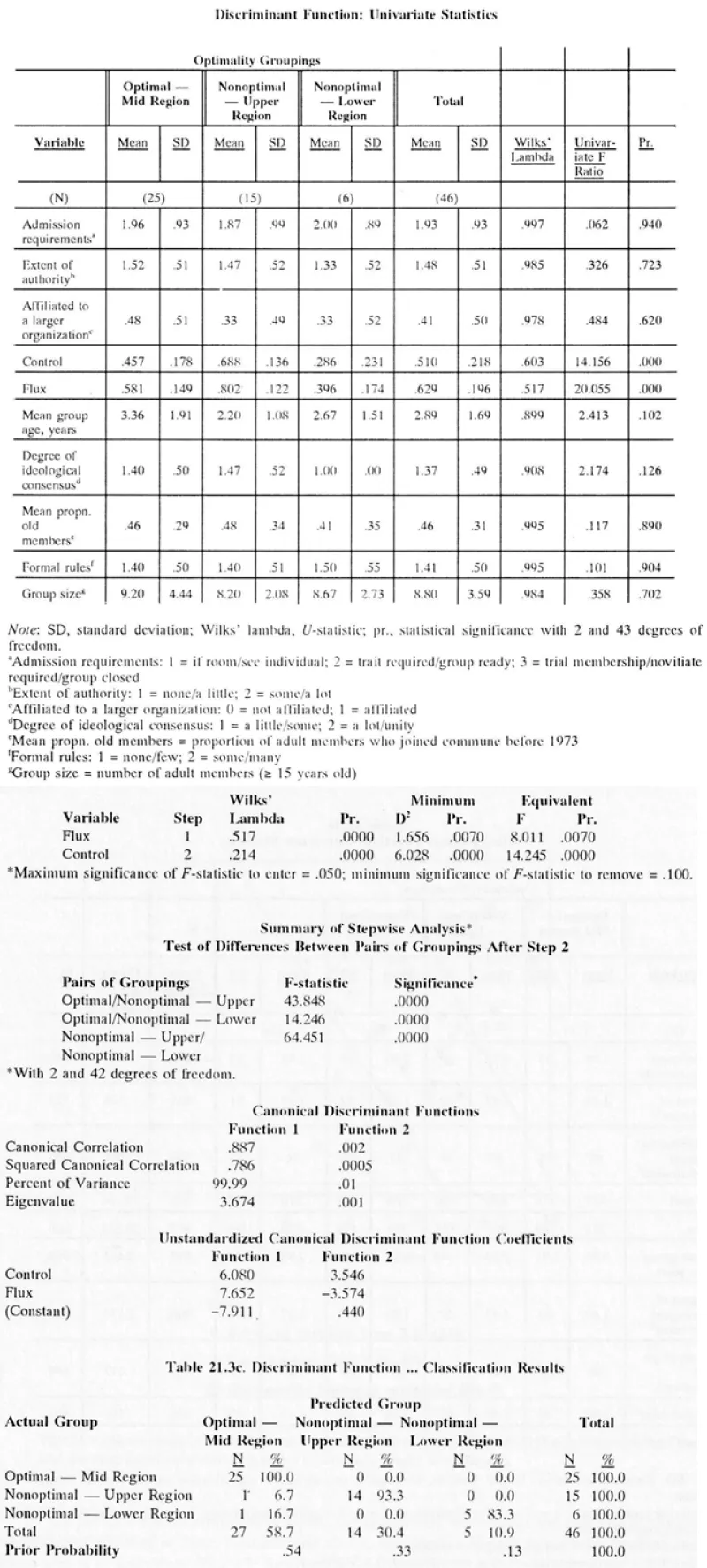
Table A: Discriminant Function Analysis of Optimality Classification of Communes: Univariate Statistics, Stepwise Analysis, Canonical Discriminant Function, and Classification Results. (Source: adapted from Bradley and Pribram (1997), Tables 21.3a through 21.3c, pages 477- 478.)
- Pribram KH. The brain, cognitive commodities, and the enfolded order. In: Boulding KE, Senesh L, editors. The optimum utilization of knowledge: making knowledge serve human betterment. Boulder (CO): Westview Press; 1983;29-40.
- Pribram KH. Localization and distribution of function in the brain. In: Orbach J, editor. Neuropsychology after Lashley. New York: Erlbaum; 1982;273-296. Available from: https://www.karlpribram.com/t-136/
- Greenstein G, Zajonc AG. The quantum challenge: modern research on the foundations of quantum mechanics. Burlington (MA): Jones and Bartlett Publishers; 1997.
- Pribram KH. The form within: my point of view. Westport (CT): Prospecta Press; 2013. Available from: https://books.google.co.in/books/about/The_Form_Within.html?id=DHRolAEACAAJ&hl=en&redir_esc=y
- Damasio AR. Descartes' error: emotion, reason, and the human brain. New York: G;Putnam's Sons; 1994. Available from: https://ahandfulofleaves.wordpress.com/wp-content/uploads/2013/07/descartes-error_antonio-damasio.pdf
- Gabor D. A new microscopic principle. Nature. 1948;161:777-778. Available from: https://doi.org/10.1038/161777a0
- Gabor D. Theory of communication. J Inst Electr Eng. 1946;93:429-457. Available from: https://doi.org/10.1049/ji-3-2.1946.0076
- Pribram KH. Brain and perception: holonomy and structure in figural processing. Hillsdale (NJ): Lawrence Erlbaum Associates; 1991. Available from: https://www.scirp.org/reference/referencespapers?referenceid=4158705
- Miller GA, Galanter EH, Pribram KH. Plans and the structure of behavior. New York: Holt, Rinehart & Winston; 1960. Available from: https://www.scirp.org/reference/referencespapers?referenceid=1262704
- LeDoux J. The emotional brain: the mysterious underpinnings of emotional life. New York: Simon and Schuster; 1996. Available from: https://books.google.co.in/books/about/The_Emotional_Brain.html?id=uUwUmhiXTMQC&redir_esc=y
- Pribram KH. Languages of the brain: experimental paradoxes and principles in neuropsychology. New York: Brandon House; 1971. Available from: https://dokumen.pub/languages-of-the-brain-experimental-paradoxes-and-principles-in-neuropsychology-978-0913412220.html
- Tiller WA, McCraty R, Atkinson M. Cardiac coherence: a new, noninvasive measure of autonomic nervous system order. Altern Ther Health Med. 1996;2(1):52-65. Available from: https://pubmed.ncbi.nlm.nih.gov/8795873/
- McCraty R, Atkinson M, Tomasino D, Bradley RT. The coherent heart: heart-brain interactions, psychophysiological coherence, and the emergence of system-wide order. Boulder Creek (CA): HeartMath Research Center, Institute of HeartMath; 2006. Available from: https://www.integral-review.org/issues/vol_5_no_2_mccraty_et_al_the_coherent_heart.pdf
- Bradley RT, McCraty R, Atkinson M, Tomasino D, Daugherty A, Arguelles A. Emotion self-regulation, psychophysiological coherence, and test anxiety: results from an experiment using electrophysiological measures. Appl Psychophysiol Biofeedback. 2010;35(4):261-283. Available from: https://doi.org/10.1007/s10484-010-9134-x
- Pribram KH, Nuwer M, Baron R. The holographic hypothesis of memory structure in brain function and perception. In: Atkinson RC, Krantz DH, Luce RC, Suppes P, editors. Contemporary developments in mathematical psychology. San Francisco: W. H. Freeman; 1974;416-467. Available from: https://www.karlpribram.com/wp-content/uploads/2025/08/T-062.pdf
- DeValois RL, DeValois KK. Spatial vision. Annu Rev Psychol. 1980;31:309-341. Available from: https://doi.org/10.1146/annurev.ps.31.020180.001521
- DeValois RL, DeValois KK. Spatial vision. New York: Oxford University Press; 1988. Available from: https://books.google.co.in/books?id=_fO6wzoVK2wC&printsec=copyright&source=gbs_pub_info_r#v=onepage&q&f=false
- Von Bekesy G. Experiments in hearing. New York: McGraw-Hill; 1960. Available from: https://www.scirp.org/reference/referencespapers?referenceid=1695339
- Bernstein N. The co-ordination and regulation of movements. London: Pergamon Press Ltd; 1967. Available from: https://www.scirp.org/reference/referencespapers?referenceid=1652379
- Bradley RT. Harnessing the force of all creation: part one. The power of love to shape reality. World Futures. 2024;80:1-35. Available from: https://doi.org/10.1080/02604027.2024.2340769
- Bradley RT, Torris CT. Women, the heart of intuition, and creation entanglement. Front Psychol. 2025:1-27. Available from: https://doi.org/10.3389/fpsyg.2025.1547229
- Gabor D. Communication theory and physics. Trans IRE Prof Group Inf Theory. 1953;1:48-59. Available from: https://doi.org/10.1109/TIT.1953.1188558
- Heisenberg W. Remarks on the origin of the relations of uncertainty. In: Price W, Chissick S, editors. The uncertainty principle and foundations of quantum mechanics: a fifty years’ survey. London: J. Wiley & Sons; 1977;3-6. Available from: https://www.scirp.org/reference/referencespapers?referenceid=120253
- Nishiyama A, Tanaka S, Tuszynski JA. Towards verification of quantum brain dynamics. Unpublished manuscript. Graduate School of System Informatics, Kobe University, Kobe, Japan; 2025. Available from: https://doi.org/10.1201/9781003455714-7?urlappend=%3Futm_source%3Dresearchgate.net%26utm_medium%3Darticle
- Bohm D. Wholeness and the implicate order. London: Routledge and Kegan Paul; 1980. Available from: https://www.routledge.com/Wholeness-and-the-Implicate-Order/Bohm/p/book/9780415289795?gad_source=1&gad_campaignid=23518125819&gbraid=0AAAAACWuhHUx-riSuLq7OPbiQDOlU4kOn&gclid=CjwKCAjw687NBhB4EiwAQ645dgrPk6HR21qOb-Q43JfxNgCmmpnYh63TluKQtNGNjQe7zDx8gO-b5hoChcQQAvD_BwE
- SantaMaria M, King J, Xie M, Zheng B, Pribram K, Doherty D. Responses of somatosensory cortical neurons to spatial frequency and orientation: a progress report. In: King J, Pribram K, editors. Scale in consciousness experience: is the brain too important to be left to specialists to study? Hillsdale (NJ): Lawrence Erlbaum Associates; 1995;157-168.
- Bradley RT. Quantum vacuum interaction and psycho-social organization. In: Loye D, editor. The evolutionary outrider: the impact of the human agent on evolution. Westport (CT): Praeger Publishers; 1998;177-149.
- Bradley RT. Love, power, brain, mind, and agency. In: Loye D, editor. The great adventure: toward a fully human theory of evolution. Albany (NY): State University of New York Press; 2004;99-150. Available from: https://psycnet.apa.org/record/2004-00211-004
- Bradley RT. Charisma and social structure: a study of love and power, wholeness and transformation. New York: Paragon House; 1987.
- Bradley RT, Pribram KH. Communication and optimality in biosocial collectives. In: Levine DS, Elsberry WR, editors. Optimality in biological and artificial networks. Mahwah (NJ): Lawrence Erlbaum Associates; 1997;449-488. Available from: https://gwern.net/doc/ai/nn/1997-levine-optialityinbiologicalandartificialnetworks.pdf
- Bradley RT, Pribram KH. Communication and stability in social collectives. J Soc Evol Syst. 1998;21(1):29-81. Available from: https://doi.org/10.1016/S1061-7361(99)80005-8
- Holland PW, Leinhardt S. Local structure in social networks. In: Heise DR, editor. Sociological methodology 1976. San Francisco: Jossey-Bass; 1976;1-45. Available from: https://doi.org/10.2307/270703
- Pribram KH, Bradley RT. The brain, the me and the I. In: Ferrari M, Sternberg R, editors. Self-awareness: its nature and development. New York: The Guilford Press; 1998;273-307.
- Bradley RT. Love, consciousness, energy, and matter: heart’s vital role in coherence and creation. Cardiol Vasc Res. 2024;8:1-25. Available from: https://doi.org/10.33425/2639-8486.1181. https://www.scivisionpub.com/pdfs/love-consciousness-energy-and-matter-the-hearts-vital-role-in-coherence-and-creation-3234.pdf
- Bohm D, Hiley BJ. The undivided universe: an ontological interpretation of quantum theory. London: Routledge; 1993. Available from: https://www.routledge.com/The-Undivided-Universe-An-Ontological-Interpretation-of-Quantum-Theory/Bohm-Hiley/p/book/9780415121859
- MacLennan B. Gabor representations of spatiotemporal visual images. Technical Report CS-91-144. Computer Science Department, University of Tennessee; 1994.
- Bradley RT, Roberts NC. Network structure from relational data: measurement and inference in four operational models. Soc Networks. 1989;11:89-134. Available from: https://doi.org/10.1016/0378-8733(89)90008-7
- Tiller WA, Dibble WE, Fandel JG. Some science adventures with real magic. Walnut Creek (CA): Pavior Publishing; 2005. Available from: https://scispace.com/pdf/some-science-adventures-with-real-magic-4rxu31osal.pdf
- Bradley RT. Psychophysiology of intuition: a quantum-holographic theory of nonlocal communication. World Futures. 2007;63(2):61-97. Available from: https://doi.org/10.1080/02604020601123148
- Bradley RT. Harnessing the force of all creation. Part two. Psi-formation: psychoenergetic and quantum holographic processes. World Futures. 2024;80:1-47. Available from: https://doi.org/10.1080/02604027.2024.2340771
- Pribram KH, Melges FT. Psychophysiological basis of emotion. In: Vinken PJ, Bruyn GW, editors. Handbook of clinical neurology. Vol. 3. Amsterdam: North-Holland Publishing Company; 1969;316-341. Available from: https://www.scirp.org/reference/referencespapers?referenceid=2873911