
More Information
Submitted: April 20, 2026 | Accepted: April 27, 2026 | Published: April 29, 2026
Citation: Stefanescu E. Quantum Mechanics and General Relativity. Int J Phys Res Appl. 2026; 9(4): 88-128. Available from:
https://dx.doi.org/10.29328/journal.ijpra.1001151
DOI: 10.29328/journal.ijpra.1001151
Copyright license: © 2026 Stefanescu E. This is an open access article distributed under the Creative Commons Attribution License, which permits unrestricted use, distribution, and reproduction in any medium, provided the original work is properly cited.

Quantum Mechanics and General Relativity
Eliade Stefanescu*
Advanced Studies in Physics Centre of the Romanian Academy, Academy of Romanian Scientists, Bucharest, Romania
*Address for Correspondence: Eliade Stefanescu, Advanced Studies in Physics Centre of the Romanian Academy, Academy of Romanian Scientists, Bucharest, Romania, Email: [email protected]
In this paper, we reformulate the quantum theory according to a more detailed understanding of the fundamental laws of Planck, Einstein, and de Broglie. In this framework, a quantum particle is described as a distribution of matter in the two conjugate spaces of the coordinates and momentum. The mass quantization of a quantum particle arises from the matter dynamics according to general relativity. From the propagation equations of the two wavefunctions, in the coordinate and momentum spaces, including the scalar and the vector potentials of an electromagnetic field, we obtain Lorentz’s force and Maxwell’s equations. By the application of this new theory to important problems of quantum field theory, quantum electrodynamics, flavor-dynamics, and chromodynamics, a unified theory of the four forces acting in nature is obtained. Based on Dirac’s formalism of general relativity, we describe the dynamics of a quantum particle in the gravitational field of a black hole, and propose a new model of our universe in full agreement with classical logic and general relativity. We show that the new wavefunctions of a quantum particle include the graviton spin, as a rotation of the gravitational potential dressing this particle, and the particle spin as a particle matter rotation.
A. The theoretical quantum mechanics and posing fundamental problems
The traditional quantum mechanics [1-15], invented one hundred years ago, is probably the most important field of our science and civilization, standing at the basis of our understanding of the world we live in and of the most remarkable applications, such as the nuclear, semiconductor, and optical technologies. However, during its already long history, quantum mechanics encountered difficult discussions, as Feynman said that nobody understands quantum mechanics [16-24], and Einstein, who never accepted this quantum theory, published his famous article with Podolsky and Rosen, where he found this theory to be an incomplete one [25]. Of course, Niels Bohr answered, asserting that their arguments do not seem to him “to meet the actual situation with which we are faced in atomic physics” [26]. Although in principle I agree with Einstein, in the sense that the traditional quantum mechanics is inconsistent [27], in a sense I agree with Niels Bohr, namely that the Einstein-Podolsky-Rosen arguments do not reveal any incompleteness: according to quantum mechanics, when a quantum particle decays in two fragments, these fragments have correlated spins due to the total spin conservation law – it is not correct to consider a two particle description with two correlated spins, and, after that, to describe the same dynamics by two independent particles, and say that the spin of one fragment should be independent on the spin of the other fragment. In my opinion, no inconsistency arises in the traditional quantum mechanics from the description of such an experiment, since, according to this theory, the whole dynamics should be described as of a two-particle system, where the two spins remain correlated no matter the particle distance. However, as Einstein considered, on the other hand, the traditional quantum mechanics, as a probabilistic theory, does not explain such a large distance correlation of the states. Later, to explain this phenomenon in the framework of a probabilistic theory, a model based on a system of hidden variables has been proposed [28,29]. Recently, this correlation, which is essential for the very important application field of quantum computers, has merely been introduced in quantum mechanics as a property of the compound systems called “entanglement” [30,31]. It is remarkable that, according to our new quantum theory, we present in this paper, entanglement is a natural property of a system of quantum particles, which, in this framework, are described as classical distributions of matter, quantized according to general relativity [32-37].
However, the traditional quantum mechanics, essentially based on the Schrödinger equation, with the strange physical interpretations of the planetary atomic model, with Niels Bohr’s amendment of the rotating electrons without any field radiation, the particle-wave duality, and Heisenberg’s uncertainty principle, has finally been accepted as a fundamental theory. The big success of this theory is mainly based on its very good description of the atomic steady states, but the steady state Schrödinger equation, in fact, is only the eigenvalue equation of the Hamiltonian. A remarkable mathematical theory for a system of quantum particles, with vectors describing states, operators for observables, and matrices describing transitions between these states, has been created by Dirac, who also generalized this theory for the relativistic case, but without any understanding of the particle masses, remained only as phenomenological quantities, and, as we shall see later, without a complete description of the relativistic dynamics. Although the dynamics of a quantum system in a curved spacetime can be theoretically described, a probing of the relativistic effects encounters the difficulty that the curvature differences on the length scale are very small compared to the typical extents of the quantum effects. However, J. P. Covey, I. Pikovski, and J. Borregaard showed that quantum theory in a curved spacetime could be probed by using an atomic clock delocalized between three widely separated atomic systems in Earth’s gravitational field [38,39].
B. Problems of quantum mechanics and a reformulation of this theory according to general relativity
For a better description of the quantum systems, this theory has been generalized for dissipative systems, also called open systems [40], essentially based on master equations [41-45]. On this basis, important physical phenomena, such as dissipative atom-field interaction [46-48], dissipative tunneling [49-52], and giant resonances as collective states with dissipative coupling [53], have been described. In this way, we obtained theoretical results in very good agreement with experimental data, as the asymmetry of the transmission characteristics of an active Fabry-Perot resonator with the atomic detuning [46], the fission spectra of the nucleus 252Cf in 148Ba+104Mo and 146Ba+106Mo [51-53], and the ratio of the two giant resonance spectral widths of heavy nuclei [51]. More than that, in this framework, we obtained new physical phenomena, as the dissipative coupling of the polarization with the population in a revised Bloch-Feynman system of equations, describing a possible amplification of a coherent electromagnetic field by propagation through a dissipative resonant environment [46-48], and an increase of the tunneling rate by dissipative coupling [49-52].
The axiomatic quantum master equations, originally obtained by Lindblad, Davies, Sandulescu and Scutaru, and Alicki and Lendi [41-44], respecting the quantum characteristics, such as the density matrix positivity, the uncertainty relations, and the zero-point motion, have the big disadvantages of unspecified dissipative couplings of the system operators, which can be described only by phenomenological parameters. For a quantitative description of an open quantum system, an analytic master equation for a system of fermions, with explicit microscopic coefficients for dissipative couplings to an environment of other fermions, bosons, and a free electromagnetic field, has been obtained [54-57]. In this framework, a system of semiconductor devices converting the environmental heat into usable energy has been invented [58-60], based on a semiconductor structure we called a quantum injection dot [61], and described in detail [62-64]. It is remarkable that such a complex system, of semiconductor structures coupled to a resonant electromagnetic field in a system of resonant cavities, with an injection system of electrons, does not respect any more the second law of thermodynamics, valid for molecular systems [65,66].
Although the traditional quantum theory has been used for the description of interesting phenomena and important technologies, it encountered big difficulties: inconsistencies with the classical logic, ontology, cosmology, and general relativity, singularities in the description of the particle collisions, and incompatibilities in the description of the four forces acting in nature. In this paper, we present a new quantum theory, in perfect agreement with fundamental laws of Planck, Einstein, and de Broglie, where these difficulties are avoided [27,32-37,67-71]. This is a unitary theory of quantum mechanics [1-15] and relativity [72-74], where we use Dirac’s formalisms of quantum mechanics [3] and general relativity [75]. In the next section, we present the main results of this theory, where, for clarity, we also include the main concepts and ideas leading to these results.
In this chapter, II. RESULTS, as the traditional quantum mechanics, our new theory is also based on heuristic motivations and verified consequences of the fundamental laws of Planck, Einstein, and de Broglie, but based on a more detailed analysis of this laws, and a more rigorous mathematical derivation of the quantum dynamics in the two conjugated spaces of the coordinate and momentum, in agreement with the fundamental Hamilton equations, leading to the interpretation of the quantum particles as classical distributions of matter, quantized according to General Relativity. For a better understanding of our new theory, we consider its possible applications for A the one-particle dynamics, B the derivation of Lorentz’s force and Maxwell’s equations, C Lorentz’s Force and Maxwell’s equations in General Relativity, D a proposed experiment for probing the interplay of quantum mechanics with general relativity, E Dirac’s type fundamental equations of the quantum field theory including an additional relativistic term, and a system of a finite particle-finite antiparticle in a coherent electromagnetic field, F a revised Fermi’s golden rule including relativistic effects, G a revised quantum electrodynamic theory of a two-particle collision and of a two-particle decay of a quantum particle, H a Grand Unified Theory of the four forces acting in nature, and the quantization of the fields, I the Black Hole matter dynamics and a model of our universe with its fundamental characteristics entirely explained by the General Theory of Relativity, and J the gravitational waves, the graviton spin as a rotation of the metric tensor, and the particle spin as a rotation of its matter, but, of course, without entering too much into details, which are beyond the objectives of this article. The new results are in agreement with the validated results of the traditional quantum mechanics for the steady states, but, beyond these, it explains a lot of phenomena in contradiction, or unexplained by the traditional quantum mechanics, such as the entanglement, which, in the traditional quantum mechanics has been introduced from the outside, and which, according to our theory is a natural one, as a correlation between classical particles, unperturbed by intrinsic uncertainties. More than that, our theory provides important physical laws such as the electromagnetic Lorentz and Maxwell laws, a unified theory of all the forces acting in nature, relativistic, logically understandable terms in the quantum field equations and quantum electrodynamics, and explains the graviton spin as a rotation of the gravitational potential, and the particle spin as a matter rotation. In this framework, the black hole matter dynamics and the fundamental characteristics of our universe are explained. The theoretical approaches of these subjects is favoured by Dirac’s formulation of General Relativity, and the heuristic approach which led to the famous traditional quantum mechanics, which, by this theory, is brought to a more correct and understandable form.
In section III, we discuss the famous experiments, which led to the traditional quantum mechanics, and now, by a more detailed analysis, based on the traditional concepts of states and operators, we obtained the new quantum mechanics presented in this paper. Section IV is for conclusions.
A. Relativistic quantum dynamics of a quantum particle as a distribution of matter and the matter quantization
In the traditional quantum mechanics, the nonrelativistic dynamics of a quantum particle in a potential is described by the Schrödinger wave equation
, (1)
describing the propagation in the time t of this particle, considered a punctual entity, with the coordinates , and the Hamiltonian
, (2)
depending on the mass M as a phenomenological quantity.
Schrödinger’s equation (1) for a particle with the energy , with a solution
. (3)
seems to be in agreement with the Planck-Einstein law of the quantum particle oscillation with a frequency proportional to the particle energy, , with the Hamiltonian operator
.(4)
With the de Broglie law for a quantum particle as a wave with a wavevector proportional to the momentum,, the wavefunction (3) takes a form
, (5)
as the momentum operator is
. (6)
With this operator, Schrödinger’s equation (1) with the Hamiltonian (2) takes its explicit form
, (7)
with a solution of the form (5), which, with the superposition principle, takes the form of a Fourier series expansion
, (8)
which, with the inverse Fourier transform
, (9)
satisfy the normalization conditions
, (10)
We notice that the Schrödinger equation (7) does not describe the particle wavefunction (8), but only the waves, the Fourier components, of this wavefunction, propagating with the velocities
(11)
in the two conjugated spaces of the coordinates and momentum. Since this system of equations is in disagreement with the Hamiltonian system of equations,
(12)
we conclude that Schrödinger equation (7) is not correct.
To obtain a correct dynamic equation for a quantum particle, we go back to the fundamental quantum equations of Planck, Einstein, and de Broglie (Figure 1).
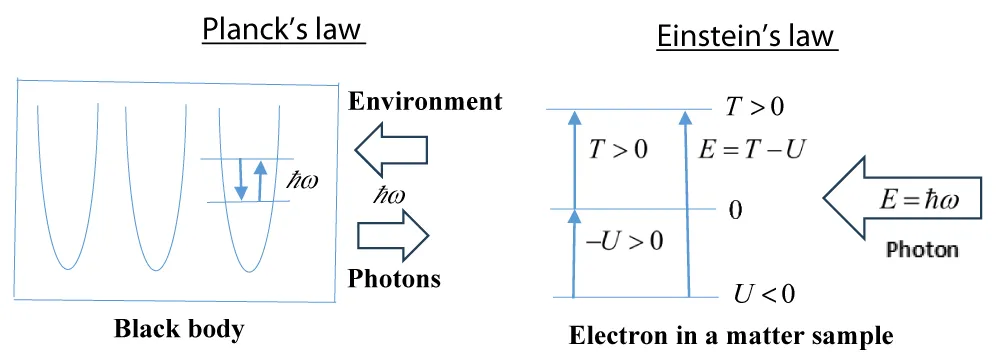
Figure 1: Planck’s and Einstein’s laws of the photon interaction with electrons in a black body, and in a matter sample with an electron bond potential energy U < 0.
According to Planck’s law, a black body is a system of oscillators in a large range of frequencies ω, interacting by photon emission-absorption processes with an environment. The essential aspect of this law, we are interested in here, is that the frequency of the matter oscillators is the same as the frequency of the photons interacting with this matter. In this interaction process we face a double resonance, an energy resonance, and a frequency resonance. According to Einstein’s law, a photon with a sufficiently large energy , can be absorbed in a matter sample when an electron of this sample is extracted, by cancelling its potential energy U < 0, and transferring the energy difference to this electron as a kinetic energy T > 0. This means an energy resonance E = T -U, and a frequency resonance, , which means that the electron vibration frequency corresponds to its Lagrangian, not to its Hamiltonian as it is described by Schrödinger’s equation. This means that an electron of an energy , with the corresponding Lagrangian
(13)
and the wave functions
(14)
is described by the nonrelativistic wave functions
(15)
which are in agreement with the Hamilton equations (12).
In general relativity, with the coordinates , the normalized velocities , as functions of the local velocities in the proper time τ as a parameter, the metric tensor , the invariant time-space interval
, (16)
with the fundamental equation
, (17)
and the relativistic Lagrangian
, (18)
the wavefunctions (14) take the explicit form
(19)
With the momentum
(20)
we obtain the wave velocities in the two conjugated spaces, of the coordinates and momentum,
(21)
It is remarkable that, in the proper time τ, the velocities of the wavefunction Fourier components in the coordinate space are equal to the velocity of the coordinates of this wavefunction . Consequently, we conclude that the two wavefunctions (19) describe the dynamics of a distribution of matter with a density of the form
, (22)
as, with the normalization equations (10), the total mass is
(23)
This means that the mass of a quantum particle as the integral of its density, M0, is equal to the mass M, as a parameter of the particle matter interaction with the gravitational field, which, according to (21), is proportional to the gradient of the metric tensor.
This property of a particle wavefunction, can also be understood from its expression (14),
. (24)
From (21) and (24), we conclude that the wavefunctions of a quantum particle in a gravitational field, and of a free quantum particle with an energy E, i.e., which is not accelerated by and external, nongravitational force, keep their shapes during their motions. In other words, only interactions by external, electromagnetic, weak, or strong forces, could change the shape of a quantum particle, which, otherwise remains the same.
Since in the dynamics of a quantum particle in a scalar, external potential field , the gravitational field which is much weaker, is generally neglected, we consider wavefunctions in the special relativity,
(25)
where we distinguish the coordinate dependent operators, which we call propagation operators,
, (26)
applied to the time-dependent wavefunctions,
(27)
which satisfy the dynamic equations
(28)
We notice that the first equation has the Schrödinger-like form
(29)
for the particle matter distribution, with the total derivative describing the time-variation of this distribution, and a changed sign for the Hamiltonian, or energy. With a solution of the form
from equation (29),
,
we obtain
,
which means that unlike the Schrödinger equation, with partial time derivative, the new equation (29), with total time derivative of the wavefunction, describes an invariant distribution of this wavefunction.
B. Lorentz’s force and Maxwell’s equations obtained from the interaction of an electromagnetic field with a quantum particle
We consider the electromagnetic field dressing a quantum particle
(30)
with a Lagrangian depending on the electric charge e, the electric potential , and the vector potential ,
. (31)
From this Lagrangian we obtain the canonical matter-field momentum
, (32)
as the sum of this particle momentum
, (33)
and the electromagnetic momentum . From these expressions we obtain the total matter-field Hamiltonian,
. (34)
as the sum of the particle energy
, (35)
where we introduced the notation with the dimension of a momentum, which we call normalized energy, with the electric potential energy,
. (36)
Form equation (33), we obtain the normalized velocity
, (37)
from where we obtain the Lorentz coefficient
(38)
as the Hamiltonian (34) gets the canonical form
(39)
From the conservation equation of the energy, , and of the canonical momentum, (32), we obtain the relations
, (40)
which means that the vector potential of an electromagnetic field interacting with a quantum particle is rotating perpendicularly to the canonical matter-field momentum, with a constant amplitude, as the particle wavefunctions (30) take the explicit form,
(41)
where we considered the total energy conservation of the matter-field system. Thus, from the first wavefunction, we obtain the wave velocities equal to the matter velocity
, (42)
which means that the shape of this particle in electromagnetic field remains unchanged. A change of the particle shape is possible only by a collisional process, when a photon exchange between the two colliding particles arise in the corresponding vertex of the Feynman diagram.
From the second wavefunction (41) with the Lagrangian (31) of a charged quantum particle, from the wave velocities in the momentum space,
, (43)
we obtain Lorentz’s force
, (44)
as a function of the electric field and the magnetic induction, as functions of the electromagnetic potentials, and acting on this particle,
(45)
From these expressions, we obtain the Gauss-Maxwell equation for the magnetic induction,
, (46)
and, with the gouge condition
, (47)
the Gauss-Maxwell equation for the electric field,
, (48)
which depends on the charge density
, (49)
as a source of the field/potential acting on this quantum particle.
At the same time, from equations (45) we obtain the Faraday-Maxwell equation of the electric field induced by the time variation of the magnetic induction,
. (50)
In this way, for a quantum particle described by the wave packets (30), in a field described by the potentials and in the time-dependent phases of these wave packets, we obtained the Lorentz’s force (44), and three of the four Maxwell equations, for the divergences of the magnetic induction (46), and of the electric field (48), and for the curl of the electric field (50). To obtain the fourth Maxwell equation, for the curl of the magnetic field, we calculate the curl of the Faraday-Maxwell equation (50),
. (51)
considering the propagation of the electric field according to a wave equation, with a decay rate γ, in the environmental charge with the density (49),
. (52)
From these equations, we obtain equation
, (53)
from which, by neglecting the nonuniformities of the environmental charge density , we obtain the curl of the magnetic induction,
. (54)
With the magnetic field
, (55)
depending on the magnetic permeability , as the field/light velocity is
, (56)
the electric induction
, (57)
and the electric current density
, (58)
depending on the electric conductivity, as the product of the electric permittivity with the decay rate of the electric field in its propagation through this environment,
, (59)
equation (54) takes the form of the Ampère-Maxwell law, of the magnetic field induced by an electric current and a time variation of the electric induction,
. (60)
Thus, we obtain the whole set of Maxwell equations (46), (48), (50), and (60), which, with the definition relations (55) and (57), for the two electric and magnetic fields, are
(61)
From the divergence of the last equation, Ampère-Maxwell, with the first equation, Gauss-Maxwell for the electric field, we obtain the electric charge equation of conservation,
. (62)
For the righthand side of this equation, we consider the form
, (63)
from which, for an environmental matter velocity , in the direction of the electric field, with a coefficient called mobility,
, (64)
we obtain
. (65)
From this expression with (58), we obtain the conductivity as the product of the environmental charge mobility with the density of this charge
. (66)
From this equation with (59), we obtain the electromagnetic field decay rate as a function of the environmental charge density and its mobility,
. (67)
Following Dirac [65,66,73], according to (56) we consider the dimensional coefficients
, (68)
the normalized environmental charge,
, (69)
and the normalized current density according to (65),
, (70)
as the Maxwell equations takes the form
(71)
We note again that these equations and Lorentz’s force (44) are entirely obtained from the dynamics of a quantum particle, described by the wavefunctions (30), as wave packets with time-dependent phases with the coefficient (31), which include the relativistic Lagrangian and interaction terms proportional to the particle charge e, and the electromagnetic potentials and .
C. Lorentz’ force and Maxwell’s equations in General Relativity
We consider the action integrals for a quantum particle interacting with a gravitational, internal field, and an electromagnetic, external field. This means the gravitational action as a scalar integral of the total curvature R with the determinant of the metric tensor g,
, (72)
the mass action, as a scalar integral of the mass density ρ,
, (73)
the electromagnetic field action,
, (74)
Where
, (75)
is the asymmetric electromagnetic field satisfying the Maxwell equations (71),
, (76)
as a function of the potential four-vector
, (77)
and the electric charge action
, (78)
depending on the charge flow density
. (79)
From the gravitational action (72), we obtain the variation equation
, (80)
depending on the metric tensor variation, which leads to Einstein’s equation of gravitation in vacuum,
. (81)
We consider the mass action (73) as a function the momentum four-vector density
, (82)
depending on the velocity in the proper time τ. With the invariance relation (17), this action takes the form
, (83)
from which, with the gravitational action
, (84)
we obtain the variation equation
(85)
depending on the variations of the metric tensor and of the coordinates.
From the electromagnetic field action (74), we obtain the variation equation
, (86)
depending on the variations of the metric tensor and of the electromagnetic potential.
From the electric charge action (78), we obtain the variation equation
, (87)
proportional to the charge density, and depending on the variations of the electromagnetic potential and of the coordinates.
From these equations, with a notation similar to (84) for the electromagnetic action,
, (88)
the strength energy tensor
, (89)
and the coefficient
, (90)
we obtain the variation equation of the total action
(91)
The coefficients of equations (84) and (88) come from the relations between mass and gravitational force and between the electric charge and the field generated by this charge, respectively. The coefficient (90) comes from the relation between Lorentz’s force and the electromagnetic field inducing this force.
From the first integral of this equation, depending on the metric tensor variation, we obtain the gravitation equation
, (92)
as the total curvature determined by the mass density with the gravity coefficient , without being influenced by the electromagnetic term, which reduces to null.
From the second integral of equation (91), depending on the coordinate variation, and the geodesic equation,
, (93)
we obtain the variation of the geodesic dynamics under the action of the electromagnetic field,
, (94)
which, by integration over the volume of the particle, with the mass M and the charge e, takes the Lorentz form for general relativity:
(95)
Compared to the traditional Lorentz’s force, describing only the spatial acceleration in the local time, these equations describe the four-dimensional time-space acceleration in the proper time.
From the last integral of equation (91),
, (96)
with the definition equation of the electromagnetic fields (75) and (76), we obtain the covariant divergence of the electric field, and the time derivatives of this field as functions of the curl terms of the magnetic field and environmental charge density,
(97)
where the first equation corresponds to the Gauss-Maxwell law of the electric field, and the other, three equations, correspond to the Ampère-Maxwell law of the magnetic circuit. At the same time, from the definition equations of the electromagnetic fields, (75) and (76), we obtain equation
, (98)
with the explicit forms of this equation for the time components
(99)
which corresponds to the Faraday-Maxwell law of the electromagnetic induction, and for the spatial components,
, (100)
which corresponds to the Gauss-Maxwell law for the magnetic field. In this way, we obtain a generalization of the whole system of Maxwell equations for the electromagnetic field in general relativity,
(101)
We note that the two equations including matter, namely the electric charge density, contain covariant derivatives of the fields, as the other two equations relating the fields without matter terms, contain only ordinary derivatives. The matter equations, which are the gravitation law (92), Lorentz’s force (95), the first equations (101), Ampère-Maxwell, and the third equations (101), Gauss-Maxwell, come from the least action principle, described by the null variation equation (91), for the variations of the metric tensor, of the coordinates, and of the electromagnetic potentials, respectively. At the same time, the second set of equations (101) and the fourth equation (101) come only from the expressions of the fields as functions of the electromagnetic potentials (75)-(77), which describe the dynamics of a quantum particle, as coefficients of the time phases of the Fourier components of the matter distribution of this particle.
D. On the relation of quantum mechanics with general relativity and a proposed experiment for probing the interplay between these theories
In the previous subsection we essentially showed that a quantum particle is a distribution of matter, which due to its dynamics according to general relativity is described by a packet of waves propagating with the same velocity, that we call the particle velocity. The shape of this particle depends on the distribution function of this matter in the momentum space. It is remarkable that under the action of a field, gravitational, electromagnetic, weak, or strong, due to the total energy conservation, the shape of this particle, i.e. particle mater distribution, remains unchanged. This means that a change of a particle shape is expected only by a collision process, when the particle-field energy is no more conserved. On the other hand, for probing the interplay between the relativistic and quantum phenomena, which stands at the basis of this property, an experimental procedure has been conceived [38,39]. This experiment, clearly illustrated in Figure 1 in [38], is essentially based on measuring times determined by the two successive atomic systems at lower amplitudes, where the curvature is larger, and times determined by the two successive atomic systems at higher amplitudes, where the curvature is smaller. In these experiments, the time variation between the two amplitudes can be rigorously calculated by the first equation (95), as the light propagation between these two pairs of atomic systems is described by Maxwell’s equations in general relativity (101), essentially depending on curvature. We still have not experimental data which could be compared with our theoretical results.
E. Updated quantum field theory of a relativistic quantum particle in an electromagnetic field
For a quantum particle in an electromagnetic field, we consider the two wavefunctions (41) in the two conjugated spaces, of the coordinates and momentum,
(102)
with the Hamiltonian (39) of Dirac’s relativistic form,
(103)
depending on the Hermitian Dirac’s spin operators , with the anticommutation relations
. (104)
From equation (103), for the momentum four-vector of a quantum particle in electromagnetic field,
, (105)
we obtain the invariance equation
, (106)
with Dirac’s operators satisfying the Clifford algebra,
. (107)
In the following, we consider a flat space,
. (108)
as the anticommutation relations (107) take the form
. (109)
and these operators have the expressions
, (110)
where is the two-dimensional unity operator and are the Pauli spin operators. With Dirac’s spin operators , the wavefunctions of a quantum particle in electromagnetic field (102) take the form
(111)
as the time-dependent wavefunctions
(112)
with the propagation operators of the particle in electromagnetic field
(113)
depending on the field propagation operators of the matter , and of the field, in the coordinate space , and in the momentum space ,
. (114)
For the time-dependent wavefunctions (112), we obtain the dynamic equations
(115)
with the canonical momentum operators
. (116)
By multiplying these equations with , the relations (110), and the notations
(117)
the dynamic equations (115) take the form
(118)
which, compared to the traditional Dirac equations [13],
(119)
include the additional relativistic term
(120)
This term depends on the conservative canonical momentum , and the amplitude of the vector potential, which, according to (40), is also a constant during the particle evolution.
With a solution of the form
. (121)
of the second dynamic equation (118),
(122)
in a system of coordinates with the third axis in the direction of motion, , from the condition of the null determinant for a homogeneous system of equations, we find energy eigenvalues for a particle and an antiparticle,
(123)
of an operator which, besides the traditional Hamiltonian P0, also includes the relativistic term.
For a particle, we obtain the eigenfunctions of the form
, (124)
depending on the particle spin eigenfunctions
. (125)
For an antiparticle we obtain eigenfunctions of the form
, (126)
depending on the antiparticle spin eigenfunctions
. (127)
The two particle and antiparticle eigenfunctions (124) and (126) are orthogonal,
(128)
and have the same amplitude
(129)
For a particle-antiparticle system, we consider a total wavefunction with the probability amplitudes α and β,
, (130)
and a covariant normalization for every one-particle wavefunction,
(131)
as this wavefunction is
(132)
With this wavefunction, we consider the solution (121) of the second dynamic equation (118) of the form
, (133)
depending on the normalization momentum interval LP. With this time-dependent wavefunction in the momentum space, the first expression (112) of the time-dependent wavefunction in the coordinate space is of the form
, (134)
for the time-dependent phase with the minus sign for a particle and a plus sign for an antiparticle. With this expression, the first wavefunction (111) in a coordinate system takes the form
(135)
of an integral over the domain occupied by the particle in the momentum space, which gives its shape in the coordinate space. Thus, for a particle-antiparticle system in an electromagnetic field, we obtain the total wavefunction
(136)
with the normalization condition
, (137)
which leads to the relation between the system domain in the momentum space, and the normalization momentum interval LP,
. (138)
We notice that the wavefunction (136) describes a particle and antiparticle with opposite electrical charges, propagating in opposite directions, in agreement with the physical model of a particle-antiparticle system produced by a photon.
F. Revised Fermi’s golden rule for quantum particle transitions between Lagrangian states in electromagnetic field
We consider a quantum particle described by a distribution of matter with an amplitude of the form (111),
(139)
as the product of the particle mass M with the density function as the squared amplitude of the time-dependent wavefunction four-vector,
. (140)
We consider this real quantity as the diagonal matrix element in the coordinate representation of the density operator,
(141)
which, in a space of states, has a representation of the form
. (142)
From the first dynamic equation (115) for a wavefunction ,
, (143)
which, with the quantum-mechanical formula for an operator A applied to a state vector and the expression of this operator applied to the wavefunction of this state,
, (144)
leads to the dynamic equation for a state ,
. (145)
With the conjugated form of this equation, we obtain the dynamic equation of the density matrix of a quantum particle,
, (146)
which, under the action of a perturbing potential , undertakes a transition from the initial state , determined by the Lagrangian LP, to the environmental states , determined by the Lagrangian functions Li, with the transition frequencies
, (147)
and the densities . We obtain the transition probability
(148)
- Fermi’s golden rule revised, depending on the transition matrix element , from the initial state , described by the dynamic equations (115) with the perturbing potential V, to the states ,
(149)
We obtain the transition potential
, (150)
depending on the transition function
(151)
We notice that the density of the transition frequencies (147), as a function of the distance between two successive final levels ,
, (152)
is the product of the traditional density of the energy states,
, (153)
and the relativistic dynamic factor
. (154)
For a cubic measuring volume , we obtain the transition frequency density
. (155)
G. Updated quantum electrodynamics
1. Two-particle collisions
We consider the collision of two particles in the states and with the energies E1 and E2, and the momenta and , scattered in the states and, respectively , with the energies E3 and E4, and the momenta and , by a photon exchange of energy E and momentum , described by a Feynman diagram with two vertices and transition matrix elements of the form
, (156)
where, according to the dynamic equation (115), the perturbing potential V which depends on the electric charge and the vector potential , is
. (157)
These wavefunctions of the form (136), with the normalization momentum intervals (138), and the normalization dimensions of the form Li,
, (158)
for the usual physical case when the dimensions of the momentum domain occupied by the particle is much smaller than its momentum , , take of the simpler form
(159)
For a collision with a particle spin inversion, which is in agreement with a photon emission-absorption process, with the energy and momentum conservations,
, (160)
for a particle, and
(161)
for an anti-particle, which moving in the inverse direction of time by a momentum increase gives a negative energy, in a collisional volume , of the colliding particles and of the photon energy exchange,
. (162)
we obtain the transition rate
(163)
It is remarkable that although the expression (156) seems to have a singularity due to the energy conservation, the equality of the energy variation from the initial energy E1 to the final energy E3 with the energy E of the emitted photon, E = E1 - E3, the final expression (163), referring to the more complex process of the particle collision has no singularity, the conservation relations (160), or (161), including two conservation conditions, of the energy, and of the momentum, for both colliding particles.
2. Two-particle decay of a quantum particle
We consider the decay of a quantum particle formed of two more stable fragments, as a process in the volume occupied by the two fragments,
, (164)
decaying in a quasi-continuum of states (i) and respectively (j), which, according to Fermi’s golden rule, (148) with (150)-(151) and (155), provides the decay rates
(165)
with transition functions for the spin conservation,
(166)
and for the spin inversion
(167)
Since the two decay rates correspond in fact to the same process, , we obtain the two-particle decay rate
(168)
We notice that a non-zero two-particle decay of a quantum particle arise only when this particle is composed of two more stable fragments, and that the decay rate is proportional to the volume of this particle.
H. Grand unified theory of the four forces acting in nature
1. Wavefunctions of a quantum particle under the action of the four forces acting in nature
We consider a quantum particle with the two conjugated wavefunctions
(169)
with a Lagrangian including the four forces acting in nature.
The relativistic Lagrangian including the gravitational force is
. (170)
For a particle with the electric charge e in an electromagnetic field acting in a one-dimensional space of this particle with the electromagnetic four-vector potential , we neglect the gravitational force, which is much smaller than the electromagnetic forces, as the particle Lagrangian takes the form
. (171)
To describe the other two external forces, the weak forces mediated by the gauge/vector bosons in the two-dimensional flavour space, and the strong forces mediated by gluons in the three-dimensional colour space, we consider the quarks as quantum particles. For a particle/quark in a two-dimensional flavor space, with the up and down states
, (173)
with the electric charges
, (174)
and the flavor charges
, (172)
we consider the electromagnetic Lagrangian terms
and . (175)
For the three Pauli operators, which can be defined in this space,
(176)
with the squared amplitudes , we consider a two-dimensional scalar potential of the weak forces,
, (177)
with the scalar potential Lagrangian terms
(178)
and two-dimensional vector potentials of the weak forces,
, (179)
with the vector potential Lagrangian terms,
(180)
For a particle/quark in the three-dimensional color space, with the red, green, and blue states
(182)
the color charges
, (181)
and Gell Mann’s spin operators, which can be defined in this space,
(183)
with the same squared amplitude, , we consider a three-dimensional scalar potential of the strong force,
, (184)
with the scalar potential Lagrangian terms
(185)
and three-dimensional vector potentials of the strong force,
(186)
with the Lagrangian terms, for a red quark in a strong vector potential,
i=1,
, (187)
i = 2,
, (188)
i = 3,
(189)
i = 4
(190)
i = 5
, (191)
i = 6
, (192)
i = 7
, (193)
i = 8
, (194)
a green quark in a strong vector potential,
i = 1,
, (195)
i = 2,
, (196)
i = 3,
, (197)
i = 4,
, (198)
i = 5,
, (199)
i = 6,
, (200)
i = 7,
, (201)
i = 8,
, (202)
and a blue quark in a strong vector potential,
i = 1,
, (203)
i = 2,
, (204)
i = 3,
, (205)
i = 4,
, (206)
i = 5,
, (207)
i = 6,
, (208)
i = 7,
, (209)
i = 8,
, (210)
According to (180), we define the weak vector potentials acting on the up and down quarks in the flavor space,
(211)
According to (187)-(210) we define the strong vector potentials acting on the red, green, and blue quarks, in the color space,
(212)
We obtain the Lagrangian terms for the six quarks, up-red,
(213)
up-green,
(214)
up-blue,
(215)
down-red,
(216)
down-green,
(217)
and down-blue,
(218)
From these Lagrngians, we obtain the corresponding momenta, for the three up quarks,
(219)
and for the three down quarks,
(220)
With these expressions, we obtain the Hamiltonians of the six quarks,
(221)
, (222)
, (223)
, (224)
, (225)
. (226)
For these six quarks, with the Hamiltonians (221)-(226), we define the charge vectors, with components in the electromagnetic, flavor, and color spaces,
, (227)
with the scalar potentials
(228)
and the vector potentials
(229)
With these vector representations, we obtain more compact forms for the Lagrangians (213)-(218),
, (230)
, (231)
, (232)
, (233)
, (234)
.(235)
the momenta (219)-(220),
(236)
(237)
and the Hamiltonians (221)-(226)
(238)
(239)
(240)
(241)
(242)
(243)
These equations, as generalizations of the of the electromagnetic equations (31), (32), and (34), lead to a generalization of the electric and magnetic fields (45),
(244)
of Lorentz’s force (44),
.(245)
and of Maxwell’s equations (71) with the dimensional quantities (68),
(246)
depending on the normalized total charge density
, (247)
and the normalized total current density
,(248)
as functions of the total charge density
.(249)
Thus, Lorentz’s force and Maxwell’s equations are not characteristics only of the electromagnetic field, but general characteristics of the three external fields dressing a particle: the electromagnetic field as a photon, the weak field as a gauge boson, and the strong field as a gluon. It is interesting that the photon and the eight gluons have no mass, as the three gauge bosons W+, W-, and Z, have mass.
2. Quantization of the fields
The quantization of the fields acting of a quantum particle is based on the equality of the photon energy according to Einstein’s law,
, (250)
with the energy obtained for the corresponding vector potential interacting with a quantum particle,
. (251)
For an electromagnetic field, from this expression, we obtain the electric field,
, (252)
with the amplitude
. (253)
depending on the photon energy which, according to the De Broglie law,
, (254)
Is
. (255)
We obtain the density of the electromagnetic energy,
. (256)
From these expressions, we obtain the volume of the photon dressing the quantum particle
.(257)
I. Cosmology
1. Black hole
A black hole is a large agglomeration of matter MG, gravitationally concentrated inside the Schwarzschild radius, which, as a function of the gravitational constant , is
.(258)
The radius rg of such a concentration of matter is a function of the volume VG occupied by this matter, with the density ρGG and the mass MG,
, (259)
which, for a matter density , of the order of Sun’s matter density , is
, (260)
approximately three orders of magnitudes larger than the Sun radius , as the black hole mass (251) is
, (261)
approximately seven orders of magnitude larger than Sun’s mass . In the gravitational field of a black hole, a particle with a null velocity at the infinity, is attracted with a radial velocity
, (262)
and a radial acceleration
. (263)
This means that an outer particle, , at a large distance, , moving towards the black hole with a velocity , is attracted towards this black hole, . However, at a smaller distance from the Schwarzschild boundary, , although the particle approaches this boundary, , it is repelled/decelerated, , reaching this boundary only at a time tending to infinity, as its velocity and acceleration tend to null. An inner particle, , moves towards the Schwarzschild boundary, , for sufficiently small values of the radius with velocities much higher than the light velocity, but being decelerated, , and reaching this boundary, only at a time tending to infinity, as its velocity and acceleration tend to null. This means that at the formation of a black hole, its central matter explodes with a velocity much larger than the light velocity, travelling towards the Schwarzschild boundary, and having the tendency to concentrate at the proximity of this boundary, but reaching this boundary, with velocity and acceleration tending to null, only in an infinite time.
To calculate the matter dynamics, we consider Einstein’s gravitation law
, (264)
and integrate this equation over the total volume,
. (265)
From this equation with the normalized radius
, (266)
we obtain that at a certain time the black hole matter is contained between two normalized radii x1 and x2, . With the state parameter
, (267)
we obtain the dynamic equation
. (268)
as equation (259) provides the connection between the two matter limits x1 and x2,
. (269)
with an initial state, t = 0,
, (270)
and a final state, ,
. (271)
For an intermediate state, let’s say the inner matter limit, from (261) we obtain the outer matter limit
, (272)
as the dynamic equation (260) is
. (273)
From this transcendental equation we obtain , as equation (264) provides the outer matter limit .
To calculate the matter time evolution, we consider the velocity (262) as a differential equation
. (274)
With the notations
, (275)
we obtain the dynamic equation
(276)
For the central matter, , with a Taylor series expansion
(277)
we obtain a velocity much larger than the light velocity,
, (278)
an explosion of the central matter at the formation of a black hole.
2. Our universe as a large black hole in the total, infinite, everlasting universe
The physics of a black hole, which begins with a big explosion of the central matter with a velocity much larger than the light velocity, and the continuous process of the emptiness of its inner part, as its inner matter concentrates at the proximity of the Schwarzschild boundary, suggests us that our universe is a system of visible bodies in the inner part of a large black hole, which explains its main characteristics: Big Bang, Inflation, its large scale small density, redshift as a gravitational effect, and the dark energy. Of course, dark matter is only a large number of uncharged quantum particles, which, by this, can be observed only by their gravitational interaction.
Considering the radius of this black hole equal to the total radius of our universe evaluated in the traditional cosmology [74], , we obtain its total mass , as the gravitational acceleration of a body at a distance rather far from the center, let us say ,
. (279)
Thia acceleration, in the gravitational field of the total universe, is much smaller than the usual accelerations of the cosmic bodies, as, for instance the radial acceleration of Earth in its motion round Sun, with the radius , and the velocity
, (280)
which is
. (281)
In fact, the acceleration of the total universe is much smaller than it is obtained by (279), since, at the formation of this large black hole in the total universe, the gravitational dynamics described by this expression is significantly perturbed by the electromagnetic and nuclear forces, spreading in all directions the inner matter that forms the bodies of our universe. In this way, the Schwarzschild metric used for the derivation of the velocity and acceleration expressions (262) and (263) describing the gravitational dynamics of the matter in the large black hole, is modified by the constant r0 which takes a much smaller value , due to the gravitational forces of the inner bodies of our universe, that partially cancel the total gravitational force of the large black hole,
(282)
To explain the redshift, we consider the time-space interval for a far quantum particle, with a radial coordinate
. (283)
and the velocity (282), this time-space interval, as an invariant for a far atom with the coordinate
(284)
where is the light frequency emitted by the atom in its proper referential. This means that the real redshift is approximately equal to the observed redshift,
, (285)
which is
. (286)
This expression is a representation of Hubble’s law, describing a proportionality of the redshift
, and, according to the Doppler effect, of the relative velocity between the two considered coordinates
. (287)
This means that this formulation of Hubble’s law does not describe a spreading of our universe, but a motion of our galaxy, which, after being thrown somewhere in the black hole hosting our universe, at its formation, by the Big Bang-Inflation process, now, after a so long time, it is attracted towards its center.
We consider a quantum particle of the large black hole of our universe in its proper time τ and its coordinates ,
(288)
with the Lagrangian
. (289)
and the time-space interval
, (290)
depending on the velocities
, (291)
which leads to the fundamental relativistic equation
. (292)
With these expressions, we obtain the momentum
(293)
With the Schwarzschild metric elements, and the corresponding velocities in the proper time,
, (294)
we obtain the Lagrangian
(295)
as an invariant, and the momentum (293),
, (296)
with two singularities. For the first singularity, r = 0, we obtain a null momentum, p1 = 0, which means that, at the formation of the black hole, a central particle is crushed up in the momentum space, being spread in the coordinate space – explosion, Big Bang. For the second singularity, r = r0, the momentum becomes infinite, , which means that, at the Schwarzschild boundary, a particle is crushed up in the coordinate space. It is interesting that, according to this expression, a particle fluctuating round the Schwarzschild boundary, is brought back towards this boundary with a quasi-infinite momentum,
. (297)
It is interesting that equation (296) with this physical consequence (297), are also obtained in a local time, as a quantum particle has wavefunctions of the form
(298)
depending on the local coordinates and velocities,
. (299)
with the Schwarzschild metric elements and the radial velocity
. (300)
We obtain the Lagrangian
(301)
and the corresponding momentum,
(302)
From this expression, we obtain the radial force acting on a quantum particle in the gravitational field of the black hole,
(303)
with the two singularities, r = 0 and r = r0. For the first singularity r = 0, we obtain a quasi-infinite force, throwing out the particle. For the second singularity r = r0, we obtain again a force bringing back to the Schwarzschild boundary any neighboring particle from the outside and from inside of this boundary.
J. Gravitational wave, graviton spin, and particle spin
In a gravitational wave, as a curvature wave, described by a coordinate variation external field, propagating according to the covariant d’Alembert equation [66],
, (304)
we consider a quantum particle
(305)
with the Lagrangian
. (306)
describing this wave by the metric tensor as a gravitational potential.
To obtain the gravitational wave for this potential from (304), we multiply this equation with , and take into account that the covariant derivative of a scalar is equal to its ordinary derivative,
. (307)
By taking into account the coordinate derivatives, , the wave equation (304) takes a form
, (308)
depending on the Christoffel symbols, which are functions of the variations of the metric tensor,
. (309)
as due to the symmetry of the metric tensor, this equation takes a simpler form
. (310)
To obtain a wave propagation equation, depending on the second derivatives with the time-space coordinates, we differentiate this equation with , and neglect the second-order terms in the coordinate derivatives of the metric tensor. We obtain the wave propagation equation
, (311)
which, by interchanging the two indices α and β, is
. (312)
It is interesting that a null Ricci tensor, describing a coordinate curvature in vacuum, includes the sum of these terms, which is null,
, (313)
plus, the ordinary d'Alembert term for the metric tensor, which, according to this equation, must also be null – ordinary d'Alembert equation for a gravitational wave,
. (314)
Since a gravitational wave emerges from the motion of a heavy celestial body, the spatial velocity induced by such a wave to a quantum particle is much smaller than the time velocity in the proper time,
, (315)
which means that the local time t is approximately equal to the proper time τ, and, consequently, the particle velocity induced by a gravitational wave in the local time is approximately the same with this velocity in the proper time, . With this expression, the velocity dependent factor of the Lagrangian (306) takes the value of the fundamental relativistic invariant,
. (316)
In this way, with the momentum of the particle,
, (317)
from the Lagrange equation as the wave velocity in the momentum space of the second wavefunction (305), we obtain the force exerted on the particle by the gravitational wave,
, (318)
from which by multiplication , and the relations (315), we obtain the particle acceleration under the action of the gravitational wave,
, (319)
proportional with the gradient of the metric tensor.
With a first-order solution of the gravitational wave equation (314),
, (320)
depending on the amplitude tensor , proportional to the scalar amplitude u,
, (321)
and the polarization vector , satisfying the normalization condition
, (322)
the dynamic equation (319) takes the form of a constant acceleration in the direction of the gravitational wave propagation,
. (323)
With a second-order solution of the gravitational wave equation (314),
, (324)
which, by taking the form
, (325)
provides the normalization condition of the polarization tensor,
, (326)
the dynamic equation (319) takes the form of a harmonic oscillator,
. (327)
For a gravitational wave propagating in the direction x3, and oscillating in the perpendicular direction x1,
, (328)
the dynamic equation (327) takes a form describing a harmonic oscillation in the same direction x1,
. (329)
We consider a gravitational wave propagating in the x3-direction, which, with the normalization condition (322), is
(330)
With the metric tensor of a weak gravitational field characteristic to a gravitational wave,
(331)
from (321) we obtain the coefficient of the two dynamic equations (323) and (329),
, (332)
as these equations take forms depending on the scalar amplitude of the gravitational wave, for the particle acceleration in the propagation direction of this wave,
, (333)
and for the particle oscillation in the oscillation direction of the gravitational wave,
. (334)
It is remarkable that from the second equation (321), by the multiplication with , we obtain an equation for the metric tensor amplitude,
. (335)
with the diagonal sum
. (336)
which, for a gravitational wave with the polarization vector , takes the form
. (337)
For a gravitational wave propagating in the direction x3, with the polarization vectors (330) and the metric tensor (331), these equations take the explicit form,
(338)
From these equations, we obtain the gravitational invariant
, (339)
describing a rotation of the metric tensor amplitude in the oscillation plane (x1, x2), perpendicular to the propagation axis x3. For a coordinate-dependent function, we consider a rotational operator with an angle , and the corresponding rotational displacement ,
(340)
For the rotation of a contravariant vector, this operator is the form
, (341)
depending on the angular momentum operator
, (342)
which, from a total rotation with an angle , is obtained with the eigenvalue 1. From the invariance of a scalar under a rotation , with the corresponding angular momentum eigenvalues,
, (343)
we obtain the expression of a rotational operator for a covariant vector,
. (344)
For the rotation with an angle of a covariant vector A,
. (345)
as for a rotation with an angle , we obtain
, (346)
With these rotational operators, with the eigenvalues and, we obtain expressions for rotations of the elements of the metric amplitude tensor contained in the invariant expression (339),
(347)
which means that under a , the two terms of this expression of this expression transform one another,
(348)
as for a rotation with an angle , they only change their sign,
(349)
At the same time, we notice that from the rotation invariance of the scalar product of the double-covariant metric tensor amplitude with two contravariant vectors,
(350)
we obtain the angular momentum of this tensor, which we call the graviton spin,
. (351)
This angular momentum, as an eigenvalue of the operator (42), describes the rotation of the metric tensor as a function of the coordinates of a quantum particle.
We notice that with the fundamental relativistic invariant (316), with a gravitational wave solution (320),
, (352)
is the product of an invariant of this wave depending on the matter velocity field, equal to the scalar wave amplitude,
, (353)
and an invariant depending on the matter coordinate field,
. (354)
The invariant IV describes a matter rotation with the velocity field correlated to the rotation of the gravitational potential amplitude , with spin 2. The invariant IC , describes this matter rotation with the coordinate field , with the polarization vector . From the normalization condition (322) of this vector, with the metric tensor (331),
, (355)
we obtain a rotation of the polarization vector in the plane perpendicular to the propagation direction x3,
, (356)
as the rotational operator means an angular momentum that is called spin, for a particle called Boson, and for a particle called Fermion. From the invariance of the scalar product (346) of the polarization vector with the coordinate vector ,
, (357)
we obtain that the two spins and describe coordinate rotations of a Boson and a Fermion. Essentially, the invariance of this scalar product describes the two spin eigenvalues for the particle matter rotations. This means that the wavefunctions (305) with the Lagrangian (306), describe not only a matter propagation according to the exponential factor , but also a matter rotation according to the relativistic invariant contained in this Lagrangian, as we have taken into account in the quantum field theory presented in subsection D.
The traditional quantum mechanics, of physical particles as punctual entities, with masses concentrated in null volumes, randomly appearing and disappearing in space according to a theory describing probabilities, and more than that, of our universe appeared from a single point initially concentrating its whole mass, without any physical understanding of what existed before, and what exists beyond its limits, meant a huge difficulty for the young people trying to understand physics, for the physicists themselves, and for the philosophers trying to understand the world we live in.
It is remarkable that all these difficulties can be avoided by a more detailed and attentive examination of the basic experiments leading to this theory, according to the basic laws of Planck, Einstein, and de Broglie. According to these laws, a particle is described by propagation waves, in time and space, with the Lagrangian conjugated to time, and the momentum conjugated to coordinates. The particle dynamics is described by the wave/group velocities in the two conjugated spaces, in the coordinate space as the matter velocity field, and in the momentum space, as the force field, acting on this matter.
The planetary model of the atom, based on the idea that an electron can have different energies in an atom only by rotations around this atom, in a solid body cannot be understood as a rotation of a small particle, but only as a particle matter rotation with an invariant shape. The shape invariance of a rotating electron is in perfect agreement with the electromagnetic theory, since the electromagnetic radiation is not produced by the rotation itself, but by a variation of the electric charge distribution. The waves describing the electron motion are merely Fourier components of the electron matter distribution.
The transition matrix element of a vertex of the Feynman diagram, which seems to have a singularity in the process of a photon emission, as equality of a colliding particle energy variation with the photon energy, in fact has no singularity, since the energy conservation of a particle with mass emitting a photon without mass, cannot satisfy the momentum conservation. The energy and momentum conservation of two colliding particles by photon exchange is a property of the whole collisional process.
We describe the four forces acting in nature, the internal force, as a curvature of the four-dimensional physical hypersurface depending on the matter mass density, producing gravity, and the three external forces: 1) the electromagnetic force, acting in a one-dimensional space, by a four-dimensional potential, 2) the weak force, acting in a two-dimensional space, called the flavor space, by the three four-dimensional potentials of the independent Pauli operators, which can be defined in this space, and 3) the strong force, which acts in a three-dimensional space, called the color space, by the eight four-dimensional potentials of the Gell-Mann operators, which can be defined in this space. For the six quarks, up-red, down-red, up-green, down-green, and up-blue, down-blue, we obtain six Lagrangians, as sums of three terms: 1) the relativistic Lagrangian, 2) the scalar product of the complex charge with the complex scalar potential, and 3) the scalar product of the complex charge with the vector potential-velocity product. In fact, we distinguish dark matter, with mass but without any charge, and visible matter, with electric, flavor, and color charges, corresponding to the three possible external forces. The relativistic Lagrangian, proportional to the square root of the time-space interval, as the product of the metric tensor with the external square of the matter velocity, describes a gravitational field rotation, called the graviton spin, correlated with the particle matter rotation, called the particle spin.
The outer part of a black hole is a time-like region, with a positive time term and a negative space term, as the inner part of the black hole is a space-like region, with a negative time term and a positive space term – under the action of gravitation, a black hole is continuously emptied by its matter, continuously concentrating at its Schwarzschild boundary. However, this gravitational process is strongly perturbed by the external forces, forming inside various objects colliding with one another, and spreading in all directions through the whole inner space. Evidently, this system of bodies, with spherical large-scale symmetry, can be described by a Schwarzschild metric, as a time-like region. The matter dynamics of a black hole suggest a model of our universe as a system of bodies in a large black hole, where its general properties, as Big Bang, Inflation, redshift, dark matter, and dark energy, are explained according to general relativity.
In this paper we reformulated quantum mechanics according to a more detailed analysis of the basic laws of Planck, Einstein, and de Broglie, in full agreement with classical logic and general relativity. According to this theory, a quantum particle is described by distributions of matter in the two conjugated spaces of the coordinates and momentum. The two conjugated wavefunctions describe the matter dynamics according to general relativity, and the mass quantization rule, as the equality of the mass as a dynamic parameter, with the mass as the integral of the matter density described by such a wavefunction as amplitude of this density. A particle wavefunction describes the particle matter distribution and propagation, by a time dependent wavefunction, with Fourier component phases proportional to time, and a propagation operator, with a phase proportional to the coordinate-momentum product, applied to this wavefunction. The time dependent wavefunctions satisfy dynamic equations similar to the Schrödinger equation, but instead of the Hamiltonian, with the Lagrangian, which leads to the agreement of the dynamics described by these wavefunctions with the Hamilton equations. According to the new theory, particle dynamics is described by two dynamic equations, in the two conjugated spaces, of the coordinates and of the momentum, depending on both operators with conservative eigenvalues, the Hamiltonian and the momentum. The physical interpretation of these wavefunctions, as amplitudes of the matter density, is based on the remarkable property of the equality of the wave velocities with the velocity of the coordinates according to general relativity.
We obtained Lorentz’s force and the Maxwell’s equations as simple theorems in the special relativity, and generalized these equations for general relativity. Based on these equations, and the experimental procedure of J. P. Covey, I. Pikovski, and J. Borregaard, clearly explained by D. Minic, the agreement of quantum mechanics with general relativity can be probed. We applied the new theory to important fields of physics, as the quantum field theory, quantum electrodynamics, a unified theory of the four forces acting in nature, and black holes, and proposed a new model of our universe, in full agreement with classical logic, classical ontology, and general relativity. It is remarkable that our universe, as a part of a four-dimensional hypersurface in the total universe with a larger number of coordinates, has a physically inaccessible neighborhood, which, on unphysical coordinates, could include objects and phenomena which cannot be detected by the four forces acting in our physical hypersurface, and other physical hypersurfaces.
- Susskind L, Friedman A. Quantum Mechanics. Basic Books. 2015. Available from: https://www.amazon.in/Quantum-Mechanics-Theoretical-Art-Friedman/dp/0465062903
- Heisenberg W. The Physical Principles of the Quantum Theory. Dover Publications Inc. 1949. Available from: https://www.amazon.in/Physical-Principles-Quantum-Theory-Physics/dp/0486601137
- Dirac PAM. The Principles of Quantum Mechanics. Clarendon Press. 1958. Available from: https://faculty.washington.edu/seattle/physics441/online/about%20Dirac.pdf
- Feynman RP. Statistical Mechanics. CRC Press. 2018. Available from: https://www.taylorfrancis.com/books/mono/10.1201/9780429493034/statistical-mechanics-richard-feynman
- Fetter AL, Walecka JD. Quantum Theory of Many-Particle Systems. McGraw-Hill. 1971. Available from: https://www.phy.pku.edu.cn/xzli/pdf/Quantum_Theory_of_Many_Particle_Systems.pdf
- Ring P, Schuck P. The Nuclear Many-Body Problem. Springer-Verlag. 1980. Available from: https://lib.ysu.am/open_books/413745.pdf
- Blaizot JP, Ripka G. Quantum Theory of Finite Systems. MIT Press. 1986. Available from: https://archive.org/details/quantumtheoryoff0000blai
- Koltun DS, Eisenberg JM. Quantum Mechanics of Many Degrees of Freedom. Wiley. 1988. Available from: https://books.google.co.in/books/about/Quantum_Mechanics_of_Many_Degrees_of_Fre.html?id=o6_vAAAAMAAJ&redir_esc=y
- Penrose R. The Road to Reality. Vintage Books. 1988. Available from: https://www.amazon.com/Road-Reality-Complete-Guide-Universe/dp/0679776311
- Pines D. The Many-Body Problem. Addison-Wesley. 1997. Available from: https://archive.org/details/manybodyprobleml0000pine
- Gasiorowicz S. Quantum Physics. Singapore: Wiley. 2000. Available from: https://sampa.if.usp.br/~suaide/MecQuantica1/Quantum%20Physics%20-%20Stephen%20Gasiorowicz.pdf
- Bruus H, Flensberg K. Many-Body Quantum Theory in Condensed Matter Physics. Oxford University Press. 2004. Available from: https://emineter.wordpress.com/wp-content/uploads/2018/10/oxford-graduate-texts-henrik-bruus-karsten-flensberg-many-body-quantum-theory-in-condensed-matter-physics-oxford-university-press-usa-2004.pdf
- Das A. Lectures on Quantum Field Theory. World Scientific. 2008. Available from: https://books.google.co.in/books?id=7AX38Cqeg3kC&printsec=copyright#v=onepage&q&f=false
- Carroll S. The Particle at the End of the Universe. Plume. 2012. Available from: https://www.preposterousuniverse.com/blog/2012/04/24/the-particle-at-the-end-of-the-universe/
- Thomson M. Modern Particle Physics. Cambridge University Press. 2013. Available from: https://library.ec.edu.iq/media/book_files/pdf/Thomson_M.-Modern_Particle_Physics.pdf
- Feynman RP, Leighton RB, Sands M. The Feynman Lectures on Physics. Basic Books. 2010. Available from: https://www.feynmanlectures.caltech.edu/
- Smolin L. Einstein’s Unfinished Revolution. Penguin Books. 2020. Available from: https://www.amazon.in/Einsteins-Unfinished-Revolution-Lee-Smolin/dp/014197916X
- Smolin L. The Trouble with Physics. Allen Lane. 2006. Available from: https://books.google.co.in/books/about/The_Trouble_with_Physics.html?id=qNlbPgAACAAJ&redir_esc=y
- Carroll S. Something Deeply Hidden. One World. 2019. Available from: https://www.amazon.in/Something-Deeply-Hidden-Emergence-Spacetime/dp/1786076330
- Pagels HR. The Cosmic Code. Bantam Books. 1983. Available from: https://archive.org/details/cosmiccodequant000page
- Lifshitz EM. From a Life of Physics. World Scientific. 1989. Available from: https://books.google.co.in/books/about/From_A_Life_Of_Physics.html?id=c2kGCwAAQBAJ&redir_esc=y
- Brown LM, Rigden JS. Most of the Good Stuff. AIP. 1993.
- Dahn R. Demythologizing quantum history. Phys Today. 2025;78(4):38. Available from: https://physicstoday.aip.org/features/demythologizing-quantum-history
- Feder T. Global movement to reform researcher assessment gains traction. Phys Today. 2023;76(10):22. Available from: https://physicstoday.aip.org/news/global-movement-to-reform-researcher-assessment-gains-traction
- Einstein A, Podolsky B, Rosen N. Can quantum-mechanical description of physical reality be considered complete? Phys Rev. 1935;47:777. Available from: https://journals.aps.org/pr/abstract/10.1103/PhysRev.47.777
- Bohr N. Discussion of EPR. Phys Rev. 1935;48:696.
- Stefanescu E. Fundamental laws and quantum dynamics. Current Physics. 2024;1:169. Available from: https://doi.org/10.2174/0127723348321035240909070125
- Bell JS. On the Einstein Podolsky Rosen paradox. Physics. 1964;1(3):195. Available from: https://journals.aps.org/ppf/abstract/10.1103/PhysicsPhysiqueFizika.1.195
- Werner RF. Quantum states with EPR correlations. Phys Rev A. 1989;40:4277. Available from: https://journals.aps.org/pra/abstract/10.1103/PhysRevA.40.4277v
- Horodecki R, Horodecki P, Horodecki M, Horodecki K. Quantum entanglement. Rev Mod Phys. 2009;81:865. Available from: https://journals.aps.org/rmp/abstract/10.1103/RevModPhys.81.865
- Nakahara M, Ohmi T. Quantum Computing. CRC Press. 2008. Available from: https://lmsspada.kemdiktisaintek.go.id/pluginfile.php/743625/mod_resource/content/1/quantum%20Computing%20-%20Nakahara.pdf
- Stefanescu E. Unitary theory of quantum mechanics and general relativity. Eur J Appl Sci. 2021;9:108. Available from: https://journals.scholarpublishing.org/index.php/AIVP/article/view/10620
- Stefanescu E. Dynamics of a quantum particle interacting with an electromagnetic field. Eur J Appl Sci. 2021;9:463. Available from: https://journals.scholarpublishing.org/index.php/AIVP/article/view/11415
- Stefanescu E. Mass and scattering of a quantum particle. Eur J Appl Sci. 2022;10:430. Available from: https://journals.scholarpublishing.org/index.php/AIVP/article/view/12165
- Stefanescu E. Fermi’s golden rule and scattering. Eur J Appl Sci. 2022;10:660. Available from: https://journals.scholarpublishing.org/index.php/AIVP/article/view/12872
- Stefanescu E. Quantum mechanics and general relativity. Ann Acad Rom Sci Phys Chem Sci. 2022;7:7. Available from: https://www.academia.edu/105138327/Quantum_Mechanics_and_General_Relativity
- Stefanescu E. Sub-relativistic quantum mechanics. APS Global Physics Summit. 2025.
- Minic D. Proposed experiment quantum gravity. Phys. 2025;18:135.
- Covey JP, Pikovski I, Borregaard J. Probing curved spacetime. PRX Quantum. 2025;6:030310. Available from: https://journals.aps.org/prxquantum/abstract/10.1103/q188-b1cr
- Li KH. Physics of open systems. Phys Rep. 1986;134. Available from: https://www.sciencedirect.com/science/article/abs/pii/0370157386901018
- Lindblad G. Generators of quantum dynamical semigroups. Commun Math Phys. 1976;48:119. Available from: https://link.springer.com/article/10.1007/BF01608499
- Davies EB. Quantum Theory of Open Systems. Academic Press. 1976. Available from: https://forum.icmuv.uv.es/event/25/attachments/51/162/Extense.pdf
- Sandulescu A, Scutaru H. Open quantum systems. Ann Phys. 1987;173:277. Available from: https://www.researchgate.net/publication/263878806_OPEN_QUANTUM_SYSTEMS
- Alicki R, Lendi K. Quantum Dynamical Semigroups. Springer. 1987. Available from: https://link.springer.com/book/10.1007/3-540-70861-8
- Isar A, Sandulescu A, Scutaru H, Stefanescu E, Scheid W. Open quantum systems. Int J Mod Phys E. 1994;3:635. Available from: https://arxiv.org/abs/quant-ph/0411189
- Sandulescu A, Stefanescu E. Optical equations two-level atom. Physica A. 1989;161:525. Available from: https://www.researchgate.net/publication/239289951_New_optical_equations_for_the_interaction_of_a_two-level_atom_with_a_single_mode_of_the_electromagnetic_field
- Stefanescu E. Dynamics of Fermi system. Physica A. 2005;350:227. Available from: https://ideas.repec.org/a/eee/phsmap/v350y2005i2p227-244.html
- Stefanescu E, Scheid W. Superradiant tunneling. Physica A. 2007;374:203. Available from: https://www.academia.edu/6924606/Superradiant_dissipative_tunneling_in_a_double_p_i_n_semiconductor_heterostructure_with_thermal_injection_of_electrons
- Stefanescu E, Sandulescu A, Greiner W. Quantum tunneling in open systems. Int J Mod Phys E. 1993;2:233. Available from: https://www.researchgate.net/publication/259026455_Quantum_Tunneling_in_Open_Systems
- Stefanescu E, Sandulescu A, Greiner W. Analytical model quantum tunneling. J Phys G Nucl Part Phys. 1994;20:811. Available from: https://www.academia.edu/115548054/Analytical_model_for_quantum_tunnelling_with_dissipation_through_a_fission_like_barrier
- Stefanescu E, Halmagean E, Sandulescu A. Dissipative effects tunneling. NATO ASI Ser B Phys. 1995;342:517.
- Stefanescu E, Sandulescu A, Scheid W, Greiner W. Cold fission. Phys Rev C. 1996;53:3014. Available from: https://journals.aps.org/prc/abstract/10.1103/PhysRevC.59.253
- Stefanescu E, Liotta R, Sandulescu A. Giant resonances. Phys Rev C. 1998;57:798. Available from: https://journals.aps.org/prc/abstract/10.1103/PhysRevC.57.798
- Stefanescu E, Scheid W, Sandulescu A. Collisional decay. Int J Mod Phys E. 2000;9:17.
- Stefanescu E, Sandulescu A. Microscopic coefficients master equation. Int J Mod Phys E. 2002;11:119. Available from: https://doi.org/10.1142/S0218301302000739
- Stefanescu E, Sandulescu A. Dynamics in radiation field. Int J Mod Phys E. 2002;11:379.
- Stefanescu E, Scheid W, Sandulescu A. Non-Markovian master equation. Ann Phys. 2008;323:1168. Available from: https://ui.adsabs.harvard.edu/abs/2008AnPhy.323.1168S/abstractv
- Stefanescu E, Cornescu LE. Longitudinal quantum heat converter. 2009. Available from: https://www.academia.edu/41516060/Open_Quantum_Physics_and_Environmental_Heat_Conversion_into_Usable_Energy_Authored_by
- Stefanescu E, Cornescu LE. Transversal quantum heat converter. 2010. Available from: https://www.academia.edu/41516060/Open_Quantum_Physics_and_Environmental_Heat_Conversion_into_Usable_Energy_Authored_by
- Stefanescu E, Cornescu LE. Quantum injection system. 2009. Available from: https://www.researchgate.net/publication/234075923_Quantum_Injection_Dots
- Stefanescu E. Quantum injection dots. 2012:299. Available from: http://www.issp.ac.ru/ebooks/books/open/Fingerprints_in_the_Optical_and_Transport_Properties_of_Quantum_Dots.pdf
- Stefanescu E. Master equation environmental heat conversion. Prog Quantum Electron. 2010;34:349. Available from: https://www.sciencedirect.com/science/article/abs/pii/S0079672710000261
- Stefanescu E. Open Quantum Physics and Environmental Heat Conversion into Usable Energy. Bentham Science. 2014. Available from: https://doi.org/10.2174/97816080598671140101
- Stefanescu E. Vol 2. Bentham Science. 2017.
- Stefanescu E. Open quantum systems and thermodynamics. J Phys Conf Ser. 2013;413:012038. Available from: https://www.researchgate.net/publication/235678211_Open_Quantum_Systems_of_Particlesand_Principle_2_of_Thermodynamics
- Stefanescu E. Open quantum matter-field systems. Curr Res Prog Phys Sci. 2024;3:67. Available from: https://stm.bookpi.org/CRPPS-V3/article/view/15461
- Stefanescu E. Vol 3. Bentham Science; 2022. Available from: https://www.benthambooks.com/ebook-files/sample-files/9789815274615-sample.pdf
- Stefanescu E. Vol 4. Bentham Science; 2024. Available from: https://www.benthambooks.com/ebook-files/sample-files/9789815274615-sample.pdf
- Stefanescu E. Unitary relativistic dynamics. Curr Res Prog Phys Sci. 2024;4:80. Available from: https://stm.bookpi.org/CRPPS-V7/article/view/17101
- Stefanescu E. Quantum mechanics and general relativity. Curr Res Prog Phys Sci. 2024;4:98. Available from: https://www.academia.edu/105138327/Quantum_Mechanics_and_General_Relativity
- Stefanescu E. Matter dynamics quantum framework. Curr Res Prog Phys Sci. 2025;7:82. Available from: https://stm.bookpi.org/CRPPS-V7/article/view/17101
- Einstein A. The Meaning of Relativity. London: Chapman and Hall; 1991. Available from: https://lectures.princeton.edu/sites/g/files/toruqf296/files/2020-08/_Albert_Einstein__Brian_Greene__The_meaning_of_rel_BookZZ.org_.pdf
- Susskind L, Friedman A. Special Theory and Classical Field Theory. Basic Books. 2017. Available from: https://eclass.uoa.gr/modules/document/file.php/PHYS181/%CE%92%CE%B9%CE%B2%CE%BB%CE%B9%CE%B1/Leonard%20Susskind%20_%20Art%20Friedman%20-%20Special%20Relativity%20and%20Classical%20Field%20Theory-Basic%20Books%20%282017%29.pdf
- Susskind L, Cabanes A. General Relativity. Basic Books. 2023. Available from: https://www.scirp.org/reference/referencespapers?referenceid=3833583
- Dirac PAM. General Theory of Relativity. Wiley. 1975. Available from: https://archive.org/details/generaltheoryofr0000dira
- Observable universe. Available from: https://en.wikipedia.org/wiki/Observable_universe