
More Information
Submitted: July 23, 2026 | Accepted: July 29, 2026 | Published: July 31, 2026
Citation: Mullat JE. The Hubble Tension Interpretation in Terms of Gnomonic Holography. Int J Phys Res Appl. 2026; 9(7): 256-260. Available from:
https://dx.doi.org/10.29328/journal.ijpra.1001163
DOI: 10.29328/journal.ijpra.1001163
Copyright license: © 2026 Mullat JE. This is an open access article distributed under the Creative Commons Attribution License, which permits unrestricted use, distribution, and reproduction in any medium, provided the original work is properly cited.
Nomenclature: Differential geometry; Cosmology; Planck’s mission; Gnomonic holography; Riemannian manifold

The Hubble Tension Interpretation in Terms of Gnomonic Holography
Joseph E Mullat*
Nygårdsvej 10, 2s., Nr.13, 2100, Østerbro, Copenhagen, Denmark
*Address for Correspondence: Joseph E Mullat, Nygårdsvej 10, 2s., Nr.13, 2100, Østerbro, Copenhagen, Denmark, Email: [email protected]
The Hubble tension—the discrepancy between early- and late-Universe measurements of the Hubble constant—remains an open problem in cosmology. This paper proposes a geometric interpretation of the Universe based on gnomonic holography, in which a Hubble-like parameter emerges naturally from the projection geometry of the 4D‑globe manifold´s 3D‑curved Riemannian hypersphere into Euclidean locally 3E‑flat space, rather than being introduced as an independent cosmological constant. Using the Planck matter-energy dencity fractions, the model predicts two characteristic gnomonic radii associated with the baryonic and dark sectors. Although these differ by only about 0.2%, the nonlinear reconstruction yields Hubble-like values of 71.63 and 67.04, closely matching the observed Hubble tension. The model also predicts an emergent timescale ratio of approximately 80.3 between the visible and dark sectors. Furthermore, it interprets the Big Bang as a phase transition of a primordial background energy field, conceptually similar to Hoyle’s phase-transition cosmology but derived from an entirely different geometric framework. Although exploratory, the proposed approach suggests that the Hubble tension may reflect an intrinsic property of cosmic geometry rather than new fundamental physics.
The Universe seemed to be speaking with two different voices. One method, based on the faint afterglow of the early Universe, predicts a slower rate of cosmic expansion. Another, relying on direct observations of nearby stars and galaxies, consistently measures a faster one.’
Both methods have been refined repeatedly, and both appear internally sound. Yet they disagree by an amount too large to dismiss as mere experimental error.
This puzzle has become known as the Hubble tension.
To many researchers, cf., Di Valentino [3] (2021), the tension signals that some piece of modern cosmology remains incomplete. New particles, unknown forms of energy, subtle observational biases, or revisions to the standard cosmological model have all been proposed. No consensus has yet emerged.
For critics of the conventional Big Bang narrative, however, the Hubble tension is more than a technical inconvenience. It serves as a reminder that even the most celebrated cosmological model rests upon assumptions that may deserve renewed scrutiny. If the Universe cannot agree on its own expansion rate, one may reasonably ask whether the story built upon that expansion is entirely secure.
History reminds us that scientific revolutions rarely begin with dramatic contradictions. They often start as persistent discrepancies—small cracks that refuse to disappear despite increasingly sophisticated measurements. Whether the Hubble tension ultimately leads to a minor adjustment of the standard model or points toward a more profound rethinking of cosmic history remains unknown.
Whatever its final resolution, the Hubble tension stands as evidence that cosmology is still a work in progress. The Universe continues to challenge our expectations, reminding us that confidence should never be mistaken for certainty.
The Hubble tension remains one of the most persistent puzzles in contemporary cosmology. Measurements based on the cosmic microwave background consistently favor a lower value of the Hubble constant, Riess [8] (2022), whereas observations relying on the local distance ladder yield higher values. Despite numerous proposed explanations, ranging from modifications of the early-Universe expansion history to new dark-sector physics, no consensus solution has emerged.
The present work explores a different possibility. Rather than introducing additional physical components or modifying established cosmological equations, we investigate whether the discrepancy may have a geometric origin within the framework of gnomonic holography. In this approach, a Hubble-like parameter arises naturally from the geometric construction itself and is not introduced as an independent empirical quantity.
A noteworthy result is that the geometric representation of the cosmological energy budget leads to two nearby but distinct characteristic radii ρb and ρd. One is associated with the baryonic component of the Universe, while the other corresponds to the combined dark sector. Although the difference between the underlying density fractions Ωb and Ωd is only about 0.2%, the nonlinear nature of the reconstruction function amplifies this separation and produces two Hubble-like values:
The resulting difference of approximately 4.59 is remarkably close to the observed Hubble tension.
At present, this agreement should not be interpreted as a proof of the model. A numerical correspondence, even a suggestive one, does not by itself establish a causal explanation. Nevertheless, the result indicates that small differences in the cosmological matter-energy balance may produce significantly different observational outcomes when viewed through the gnomonic framework. This possibility deserves further investigation.
An equally interesting consequence of the model is the emergence of a characteristic timescale ratio of approximately 80.3 between the visible and dark sectors. The physical meaning of this ratio is not yet clear. The most conservative interpretation is that it represents a difference in evolutionary rates. Under this view, structures associated with the dark sector evolve according to a characteristic timescale substantially longer than that associated with ordinary matter.
A stronger interpretation is also conceivable. If the emergent timescale t(ρ) is regarded as a genuine sector-dependent clock, then the ratio may imply different effective temporal flows in the visible and dark sectors. Such a conclusion would have profound implications for cosmology and fundamental physics. However, the current analysis does not provide sufficient theoretical or observational justification for this stronger claim, and it should therefore be regarded as speculative.
The model also raises an important methodological question. Are the characteristic radii ρ obtained independently from observational inputs, or do the assumptions used in their construction implicitly encode the observed matter distribution? The answer is crucial. If the radii are genuinely independent, then the appearance of the Hubble-tension scale may represent a nontrivial prediction of the framework. If not, the agreement may simply reflect the way the parameters have been defined. Clarifying this issue is an essential task for future work.
Viewed more broadly, the proposed framework should not be regarded as an alternative to ΛCDM but as a possible geometric interpretation of relationships that already exist within the observed cosmological energy budget. Whether the agreement obtained here is coincidental or reflects a deeper geometric principle remains an open question.
Gnomonic Holography and a Hubble-like constant
A useful modern analogy for understanding a gnomonic projection is the map displayed on an iPad or iPhone during GPS navigation. Although the Earth’s surface is two-dimensional, it forms the curved surface of a three-dimensional sphere. When a navigation application searches for a route from the user’s current position to a destination, it temporarily transforms a small neighborhood of the spherical Earth into a flat Euclidean map displayed on the screen. The user’s current position becomes the center of this local map, while nearby locations are represented by their gnomonic radius (ρ), measured from this central point. Within this local approximation, the mapped region behaves as an ordinary Euclidean plane ( ), and the covered area is simply
.
This familiar mapping illustrates the essential principle of a gnomonic projection: a curved spherical surface is represented locally by a flat plane while preserving the geometric relationships needed for practical navigation.
Crystallography applies the identical geometric principle on a much sofisticated scale. Instead of mapping cities on the Earth’s surface, the orientations of crystal faces are mapped from an imaginary sphere surrounding the crystal onto a two-dimensional plane. The crystal is conceptually placed at the center of a sphere, and the outward normals to its faces intersect the spherical surface. These intersection points are then projected onto a plane, producing a gnomonic map in which each crystal face is represented by a point, while angular relationships between neighboring faces appear as connecting arcs. Such maps allow crystallographers to visualize crystal symmetry, lattice orientation, and pole distributions with remarkable clarity.
The same mathematical idea extends naturally to cosmology. In the present work, the observable Universe is treated as a three-dimensional curved Riemannian hypersurface (S3), and a gnomonic projection maps a local neighborhood of this hypersphere into ordinary Euclidean space ( ). As in smartphone navigation, every location is characterized by its gnomonic radius (ρ) measured from the observer. Unlike the two-dimensional navigation map, however, the projected region is three-dimensional, and its Euclidean volume becomes the fundamental quantity describing the local geometry. This provides an intuitive bridge between familiar navigation maps, crystallographic gnomonic projections, and the gnomonic representation of the Universe developed here.
Consider the normalized gnomonic volume (Mullat [6], 2026):
where ρ represents the length of a rod extending from a point on the , which is locally flat super-sphere but curved at global distances, when embedded in a ℜ4 manifold. Suppose the rod increases infinitesimally in length by . The rod is connected to a differentially small area element at its apex, .
Because of averaging and evolution do not commute, the Hubble’s like H0 expansion rate inferred from observations is an effective, scale-dependent quantity determined by how local inhomogeneities are averaged into a global description [1]. Therefore, by our assumption, this increment is proportional to the corresponding change in the supersphere differential, such that
,
where H0 is a Hubble-like constant of proportionality. It follows that
.
where denotes the rate of change of the volume with respect to ρ. Using the gnomonic holographic formulation, can be expressed as
, or as
(or equivalently via an alternative trigonometric form).
Looking at expansion rate with ΛCMD, the Hubble parameter
.
Think of ΛCMD model universal “ruler expansion function”:
If increases → the universe expands;
If decreases → the universe contracts;
If stays constant → static universe.
Given Ω(ρ) but though , the coordinate ρ that comes from the gnomonic relation for the Hubble parameter, the parameter becomes
, (1)
which represents, by analogy, a reciprocal of H(t).
The Hubble Tension
The so-called Hubble tension refers to the persistent discrepancy between different measurements of the present-day expansion rate of the Universe, H0. Observations of the early Universe, particularly those derived from the cosmic microwave background measured by the Planck [7] Collaboration, consistently predict a lower value of H0, while late-Universe measurements based on visible astrophysical objects yield a higher value.
Considering the present cosmological energy balance, the combined dark-sector Ωd, the contribution may be written as
.
Meanwhile, the complementary to ,– the fraction obtained by excluding only baryonic matter is
.
This leaves a small residual difference of approximately 0.2%, potentially indicating a slight imbalance when late-time observational and CMB-derived datasets are compared.
Within the proposed framework, this difference corresponds to a separation ρb - ρd in gnomonic radii of roughly 0.046 gnomonic units, associated with characteristic visible or baryonic matter Ωb and dark sector Ωd fractions´ imbalance:
vs. respectably.
Using the gnomonic relation (1) for the Hubble constant we are not claiming that astronomers measured the gnomonic radius ρ. Instead, we define a geometric reconstruction function
.
For the function H0(ρ) evaluating two radii ρb and ρd derived from cosmological density fractions Ωb and Ωd, we obtain
, and .
The difference,
,
which is noticeably close to the mystery, although it still remains speculative.
Based on what we have shown, ρ(Ω) acts as a compressed coordinate, while H0(ρ) serves as a non-linear reconstruction function. Its reciprocal,
defines an emergent timescale associated with the geometry.
<5>The critical testIndeed, if the cosmic clock factor is identified with the inverse Hubble scale t(ρ), the corresponding function takes the form
.
Because the radii ρ are derived independently from the underlying Ω-based geometry, this result suggests, in holographic terms, that the visible and dark sectors may be associated with different characteristic timescales.
For the values 0.670227 and 3.061982, this construction yields
.
Within this framework, the clock factor of approximately 80.3 emerges naturally from the geometric construction rather than being imposed externally.
The clock exhibits two distinct regimes. Near the origin, the timescale varies approximately linearly with ρ. At larger radii, however, it decreases rapidly, scaling asymptotically as ρ-5. This behaviour suggests that ρ may encode more than spatial information alone; it may also regulate the characteristic rate at which a sector evolves.
An important question remains. The characteristic radii (ρc = 0.670227) and (ρb = 3.0619822 ) are derived from the geometric dark-matter framework developed in Mullat (2026)[6], calibrated using the cosmological parameters reported by the Planck [7] Collaboration (Aghanim et al., 2020). A central feature of this model is that the Big Bang is interpreted not as the origin of space and time through an initial singular explosion, but as a phase transition of matter, an idea that is conceptually consistent with the long-standing conjecture advanced by Fred Hoyle [4,5] and his collaborators. In Hoyle’s alternative cosmological framework, matter could emerge through continuous creation associated with phase transitions of the vacuum, rather than from a singular beginning [4-6].
This raises an important question: do the values of (ρc) and (ρb) emerge naturally from the geometry of the Mullat [6] (2026) model, thereby independently supporting this phase-transition interpretation, or do they instead reflect assumptions that implicitly impose the observed visible-to-dark matter ratio? The answer is significant because it determines whether the factor of approximately 80.3 represents a genuine prediction of the model or merely a consequence of the definitions adopted for the characteristic radii (ρc) and (ρb).
Under this interpretation, two possible readings in Figure 1 emerge.
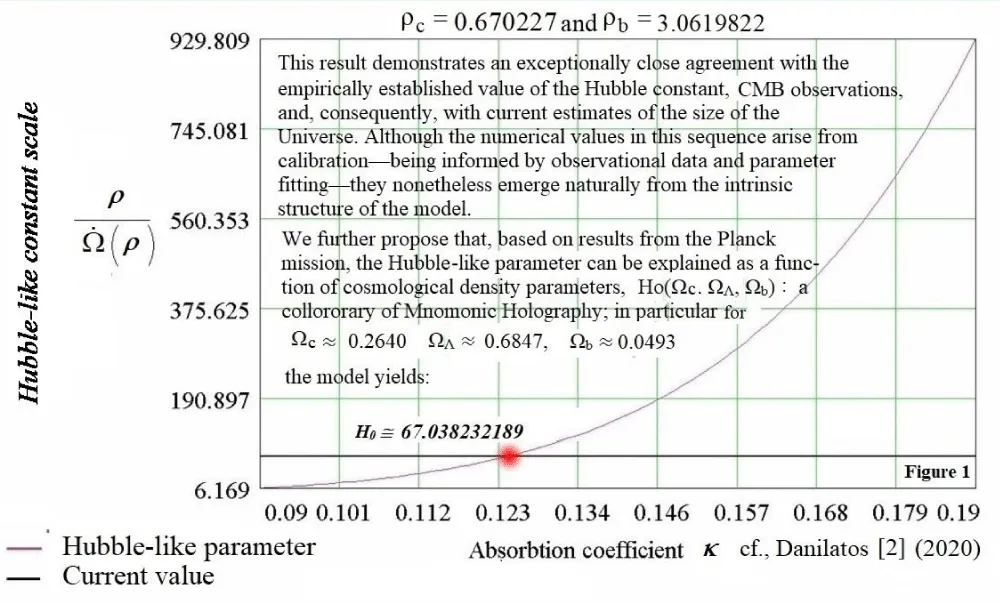
Figure 1:
Expansion-timescale interpretation in the more conservative interpretation t(ρ) represents a characteristic evolutionary timescale rather than the flow of proper time itself.
- The dark sector is associated with an evolution timescale approximately 80.3 times longer than that of the visible sector.
- As a consequence, the formation and evolution of large-scale structures would proceed more slowly when measured against the corresponding cosmological timescale.
Physical-clock interpretation gives a stronger interpreta-tion is that t(ρ) represents an actual sector-dependent clock.
- Proper time in the dark sector would then be rescaled by a factor of approximately 80.3 relative to the visible sector.
- According to this hypothesis, a process lasting one tick in the visible sector will correspond to approximately 0.0125 ticks in the dark sector, and vice versa — one tick in the dark sector will correspond to approximately 80.3 ticks in the visible sector.
The distinction between these interpretations is fundamental. The first concerns differences in dynamical evolution rates and follows directly from the emergent timescale construction. The tick attributes physical significance to those timescales as sector-dependent rates of temporal flow. Whether the model supports this stronger interpretation remains an open question and would require additional theoretical and observational justification.
Although this interpretation remains speculative, it suggests that the Hubble tension may originate from a small discrepancy of approximately 0.2% between the dynamics of observable (baryonic) matter and the gravitational effects associated with the dark sector. Within the proposed framework, this difference may reflect a subtle imbalance that is not fully captured by the conventional separation between baryonic matter and dark matter–dark energy components. In this sense, the framework may offer a possible avenue toward explaining why different observational methods infer slightly different values of the Hubble constant.
This study has explored a speculative geometric interpretation of the Hubble tension within the framework of gnomonic holography. In this approach, a Hubble-like parameter emerges naturally from the underlying geometric construction, and small differences in the cosmological energy budget lead to distinct reconstructed values that are numerically comparable to those obtained from early- and late-Universe observations.
We argue that the value of the Hubble-like constant is not merely a fitted parameter, but an intrinsic consequence of gnomonic holography combined with the hypothesis that matter emerged from a primordial energy field suggesting that the Hubble-like constant may be understood as a geometric consequence of the model rather than an independently imposed observational constant.
While the agreement with the observed Hubble tension is intriguing, the present analysis should be regarded as exploratory. Additional theoretical development is required to establish the physical foundations of the model, and independent observational tests will be necessary to determine whether the correspondence reflects a genuine cosmological mechanism or a numerical coincidence.
Nevertheless, the results suggest that geometric representations of the matter-energy content of the Universe may provide an alternative perspective on the origin of the Hubble tension. If future investigations support this interpretation, gnomonic holography could offer a useful framework for understanding why different observational methods infer slightly different values of the cosmic expansion rate.
The closeness alone is not mysterious. Because H0(ρ) is calibrated using quantities derived from the observed cosmological energy budget, obtaining values near the measured Hubble range is possible. The scientific challenge is demonstrating that the agreement is not merely a consequence of how the densities enter the construction, but rather a genuine prediction of the gnomonic framework. That is exactly the independence issue we correctly identify in our discussion.
The mathematical justification that initially motivated this work (now obsolete) was first presented in 1973 at the Institute of Managements´ Problems during a seminar by M.A. Aizerman, E.M. Braverman, and L.I. Rozonoer in Moscow. Furthermore, during the author’s work at the Tallinn Polytechnic Institute (now the Tallinn University of Technology – TalTech), the phase transition model for the formation of matter in the Universe, which incidently matched Fred Hoyle’s view, was repeatedly mentioned and discussed with the authors’ colleagues.
- Buchert T. Backreaction issues in relativistic cosmology and the dark energy debate. AIP Conf Proc. 2007;910:361‑80. Available from: https://doi.org/10.1063/1.2752486
- Danilatos GD. Novel quantitative push gravity/field theory poised for verification. North Bondi (Australia): ESEM Research Laboratory; 2020. Available from: https://zenodo.org/records/18112197
- Di Valentino E, et al. In the realm of the Hubble tension—a review of solutions. Class Quantum Grav. 2021;38:153001.
- Hoyle F. A new model for the expanding universe. Mon Not R Astron Soc. 1948;108:372‑82.
- Hoyle F, Burbidge G, Narlikar JV. A quasi‑steady state cosmological model with creation of matter. Astrophys J. a.1993;410:437‑57. 5b. Hoyle F, Burbidge G, Narlikar JV. A different approach to cosmology. Cambridge (UK): Cambridge University Press; 2000.
- Mullat JE. Cosmology that contradicts Big Bang theory. Copenhagen (Denmark): Private Publishing Platform; 2026. p.161‑204. ISBN: 978‑9403‑67‑421‑6. Available from: https://www.datalaundering.com/download/CosmologyContradictsCover.pdf.
- Planck Collaboration (Aghanim N, et al). Planck 2018 results. VI. Cosmological parameters. Astron Astrophys. 2020;641:A6.
- Riess AG, Yuan W, Macri LM, Scolnic D, Brout D, Casertano S, et al. A comprehensive measurement of the local value of the Hubble constant with km s−1 Mpc−1 uncertainty from the Hubble Space Telescope and the SH0ES team. Astrophys J Lett. 2022;934:L7. Available from: https://doi.org/10.48550/arXiv.2112.04510