
More Information
Submitted: February 12, 2026 | Accepted: February 18, 2026 | Published: February 19, 2026
Citation: Hidajatullah-Maksoed W. Economic Crisis and Earthquake Dynamics: A Nonextensive Statistical Mechanics Approach. Int J Phys Res Appl. 2026; 9(2): 037-038. Available from:
https://dx.doi.org/10.29328/journal.ijpra.1001144
DOI: 10.29328/journal.ijpra.1001144
Copyright license: © 2026 Hidajatullah-Maksoed W. This is an open access article distributed under the Creative Commons Attribution License, which permits unrestricted use, distribution, and reproduction in any medium, provided the original work is propeRLy cited.
Keywords: Econophysics; Nonextensive statistical mechanics; Tsallis entropy; Gutenberg–Richter law; Multifractals; Economic crisis modeling

Economic Crisis and Earthquake Dynamics: A Nonextensive Statistical Mechanics Approach
W Hidajatullah-Maksoed*
Prodi of Physics, University of Indonesia, 40122, Indonesia
*Address for Correspondence: W Hidajatullah-Maksoed, Prodi of Physics, University of Indonesia, 40122, Indonesia, Email: [email protected]
Men have been trying to make their lives structured and organized as time goes by. But nature never ordered, and social worlds are not simple. In the common sense, social sciences and natural sciences are different realms.
Correlated with econophysics and statistical physics, implied mathematical and logical relation between economic crisis and earthquake dynamics.
Classical physics relies on predictability, while socioeconomic systems arise from complex, connected interactions. Despite their differences, both areas show large-scale statistical patterns. Econophysics connects them by using statistical mechanics to study economic events like financial markets and income distribution [1,2].
Financial crashes and earthquakes have notable similarities. They exhibit power-law scaling, cascading failures, and heavy-tailed distributions [3,4]. This study uses nonextensive statistical mechanics to explore these parallels [5,6]. By examining their scaling properties, we aim to see if economic fluctuations follow the same mathematical patterns as seismic events, emphasizing statistical similarities instead of common physical causes.
Social statistics and statistical mechanics
Studies about “social numbers” such as marital rates, births, and marriages have been conducted since the 17th century. Statistics are reckoned as empirical tools of political economy. But then, it transformed into quantitative analysis instruments that fit with many scientific branches.
Social statistics were pioneered by Adolphe Quetelet, whereas statistical mechanics originated with Maxwell, Boltzmann & Gibbs in the middle of the 19th century. Existence of atoms and mathematical methods provided tools to explain the nature of probability distributions and molecular velocities in gas [Maxwell-Boltzmann statistics], probability distribution of states with different energies [Boltzmann-Gibbs statistics], describe Victor M. Yakovenko in “Econophysics, Statistical Mechanics Approach To”, 2008 [2].
Econophysics
The term “Econophysics” was first coined by Eugene Stanley in 1995. He defines it as a property's manifestation of a large number of men as measured by economic indicators, which is assumed to be the same as quadrate-law which is useful to explain systems that consist of a large number of matters. Case money is assumed as a medium of exchange that concentrates/conserves [1,2].
Compared to political economy, which is long-winded, narrative, and ideological, econophysics is suited by physics as a quantitative scientific branch, and she more near to econometrics [2].
Earthquake and multifractals
Earthquakes for the first time acted as a dynamic failure process on a large scale. Any geological fracture occurred from the contact between two surface rocks. Accumulatively showed whereas fracture surface stands as a fractal object [3].
Based on multifractal concepts, Tsallis (2003) proposes a generalization of Boltzmann-Gibbs statistics, which involves thermodynamic “energy” and “entropy” that are random and independent and named as “nonextensive” statistical mechanics [5,6].
Energy is a quantity that is related to possibilities, where entropy is related to probabilities of those possibilities. Energy is a basic concept and really depends on physical systems [classic, quantum, or relativistic], and entropy are informations of that physical systems.
In earthquake phenomena, a slice of earth cracks open, which acts as a source of electromagnetic waves and is called “fracto-EM/electromagnetic] emission. Experiments in laboratorium recorded that a stronger fracto-emission occurred when a not stable crack growth happened. Earthquake dynamics referred to the known Gutenberg-Richter law, which relates frequencies and magnitude of earthquakes [7].
Based on fracto-EM mechanism generalization, Stelios M. Potirakis, in “Dynamical analogy between economic crisis and earthquake dynamics within the nonextensive statistical mechanics framework,” concludes that even though they do not have physical meaning, a direct analogy is found between recorded economic evidence and fracto-EM evidence (Figure 1).
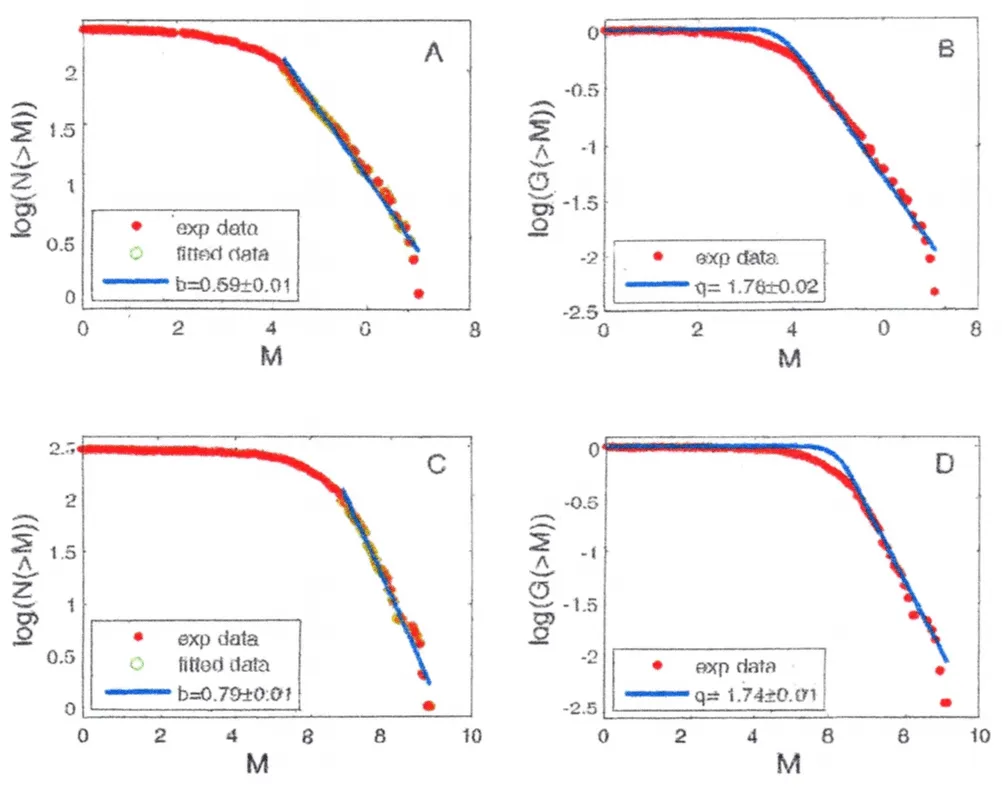
Figure 1: The S&P/TSX Composite index (GSPTSE). A. Fitting of G-R law on the trade volume events. B. Fitting of the nonextensive formula of Eq. (5) on the trade volume events. C. Fitting of G-R law on the daily price fluctuation events. D. Fitting of the nonextensive formula of Eq. (5) on the daily price fluctuation events. The employed threshold values A”noise” for V and F were 1.10E+08 and 100, respectively.
He writes:” Of course, it is impossible to define energy on economic time-series because the values related to quantities without physical meaning, especially”. The time series in that case is fitted with trade volume or daily price fluctuations [7].
Configuratively shown numerical analysis study result, which generally supports economic evidence, with good can be represented with the GR-law as well as the nonextensive model for earthquake dynamics [5,7].
Triggered earthquake
Take a look at the numerical analysis study inherent in the 4th Book of Moses “Numbers”, there are enough much earthquake can be triggered by engineering the actual mass intensity/movement. One example of man-made earthquakes that are classical are tsunamis in Aceh, Dec 26, 2004, which earned Indonesia as a laureate of Nobel Peace Prize 2006 [3].
Another example is the Herat earthquake, Oct 7 2023, engineered by Hamas, where Gaza denotes the city of Ghazni, Afghanistan, birthplace of Mahmud Al-Ghaznawi, who ruled in the years 970-1030, once with Al-Qadir Billah [3].
This study looked at the similarities between economic crises and earthquakes using nonextensive statistical mechanics. By examining their scaling behaviors and distributional properties, we found that both exhibit heavy-tailed distributions and power-law characteristics. These results imply that complex economic changes may have structural traits in common with seismic activities when viewed from a larger statistical perspective. However, this analogy is more mathematical than physical, and we need further testing with real economic data. Future research should use strict quantitative modeling to enhance the reliability and relevance of this interdisciplinary approach.
- Yakovenko VM. Econophysics: Statistical mechanics approach to. In: Durlauf SN, Blume LE, editors. The New Palgrave Dictionary of Economics. 2nd ed. London: Palgrave Macmillan; 2008. Available from: https://ideas.repec.org/p/arx/papers/0709.3662.html
- Yakovenko VM, Rosser JB. Colloquium: Statistical mechanics of money, wealth, and income. Rev Mod Phys. 2009;81(4):1703–1725. Available from: https://journals.aps.org/rmp/abstract/10.1103/RevModPhys.81.1703
- Sornette D. Critical phenomena in natural sciences: Chaos, fractals, self-organization and disorder: Concepts and tools. Berlin: Springer; 2004. Available from: https://ui.adsabs.harvard.edu/abs/2004cpns.book.....S/abstract
- Stanley HE, Amaral LAN, Gabaix X, Gopikrishnan P, Plerou V. Statistical physics and economic fluctuations. Physica A. 2002;314(1–4):66–73.
- Tsallis C. Possible generalization of Boltzmann–Gibbs statistics. J Stat Phys. 1988;52(1–2):479–487. Available from: https://www.researchgate.net/publication/226805234_Possible_generalization_of_Boltzmann-Gibbs_statistics
- Tsallis C, Bugatti E. Nonextensive statistical mechanics: A brief introduction. arXiv [cond-mat.stat-mech]. 2003. Available from: https://arxiv.org/abs/cond-mat/0305606
- Potirakis SM, Karakostas V, Eftaxias K. Dynamical analogy between economic crisis and earthquake dynamics within the nonextensive statistical mechanics framework. Physica A. 2013;392(13):2940–2954. Available from: https://arxiv.org/abs/1211.5153