
More Information
Submitted: October 19, 2026 | Accepted: November 02, 2026 | Published: November 04, 2026
Citation: Ribbands DW. The Ribbands Scale-Confinement Hypothesis. Int J Phys Res Appl. 2026; 9(11):357-364. Available from:
https://dx.doi.org/10.29328/journal.ijpra.1001170
DOI: 10.29328/journal.ijpra.1001170
Copyright license: © 2026 Ribbands DW. This is an open access article distributed under the Creative Commons Attribution License, which permits unrestricted use, distribution, and reproduction in any medium, provided the original work is properly cited.
Nomenclature: Quantum chromodynamics; Black holes; Absorption cross-section; Discrete scale invariance; Cosmological horizons; Nested cosmology; Quantum gravity

The Ribbands Scale-Confinement Hypothesis
David W Ribbands*
Independent Researcher, 7 Red lodge close, LS8 3ED, UK
*Address for Correspondence: David W Ribbands, Independent researcher, 7 Red lodge close, LS8 3ED, UK, Email: [email protected]
I investigate a speculative correspondence between colour confinement in quantum chromodynamics (QCD), causal confinement by gravitational horizons, and possible hierarchies of cosmological domains. I distinguish geometric photon capture from spectral absorption and derive scaling constraints for a proposed boundary-response recurrence. For Schwarzschild black holes, the high-frequency capture cross-section is σ_geo = 27πG²M²/c4 = (27/4)πr_s², while the gravitational compactness C = 2GM/(Rc²) is invariant under a length rescaling R → ΛR only when mass scales as M → ΛM (holding G and c fixed). I formulate a dimensionless spectral-response ansatz and a discrete-scale recurrence, then test its limits against the enormous difference between proton and black-hole compactness. I show that neither geometric scaling nor the formal similarity between critical cosmological density and a Schwarzschild mass-radius relation establishes that hadrons are miniature black holes or that the observable universe is a nucleus. A nested-domain extension is identified as an unconstructed gravitational model requiring junction conditions, stable dynamics, and discriminating observations. The contribution is an explicit, falsifiable research programme, not a demonstrated unification.
In this paper, I ask whether colour confinement, gravitational causal boundaries and cosmological domain structure may be distinct realisations of a deeper boundary-response principle. The motivating analogy is that isolated coloured quarks are not observed as asymptotically free particles, whereas outward causal signals from inside a classical black-hole event horizon cannot reach distant observers. These restrictions have different physical origins: non-Abelian gauge dynamics in QCD versus Lorentzian causal geometry in general relativity. Their analogy cannot itself establish equivalence.
My second motivation is the increase in photon capture area with black-hole mass. Size controls a geometric-optics capture cross-section but does not imply that small hadrons absorb only a narrow spectral band or that a larger black hole uniquely absorbs more kinds of light. I therefore express the proposed connection through dimensionless response functions rather than unqualified spectral claims.
My final conjecture concerns a nested hierarchy of expanding spacetime domains, with the observable universe occupying a nucleus-like role relative to a hypothetical exterior. This is a physical hypothesis only if its embedding, dynamics, matter content, and observable consequences are specified. The word “nucleus” is otherwise an analogy.
2.1. QCD confinement
A useful phenomenological approximation for the static heavy quark–antiquark potential is the Cornell form (not a complete derivation of confinement):
V(r) = −4α_s ℏc/(3r) + κr. (1)
Here κ has units of energy per length. At large separations, the rising potential favours string breaking and hadronisation; it does not describe a literal optical or gravitational event horizon. QCD confinement is a non-perturbative property of a non-Abelian gauge theory [1,2].
2.2. Schwarzschild horizons and photon capture
r_s = 2GM/c², A_H = 4πr_s² = 16πG²M²/c⁴. (2)
For null geodesics around a non-rotating uncharged black hole, the unstable photon orbit gives a critical impact parameter b_c = 3√3 GM/c². The geometric-optics capture cross-section is [3] (Figure 1):
σ_geo = πb_c² = 27πG²M²/c⁴ = (27/4)πr s². (3)
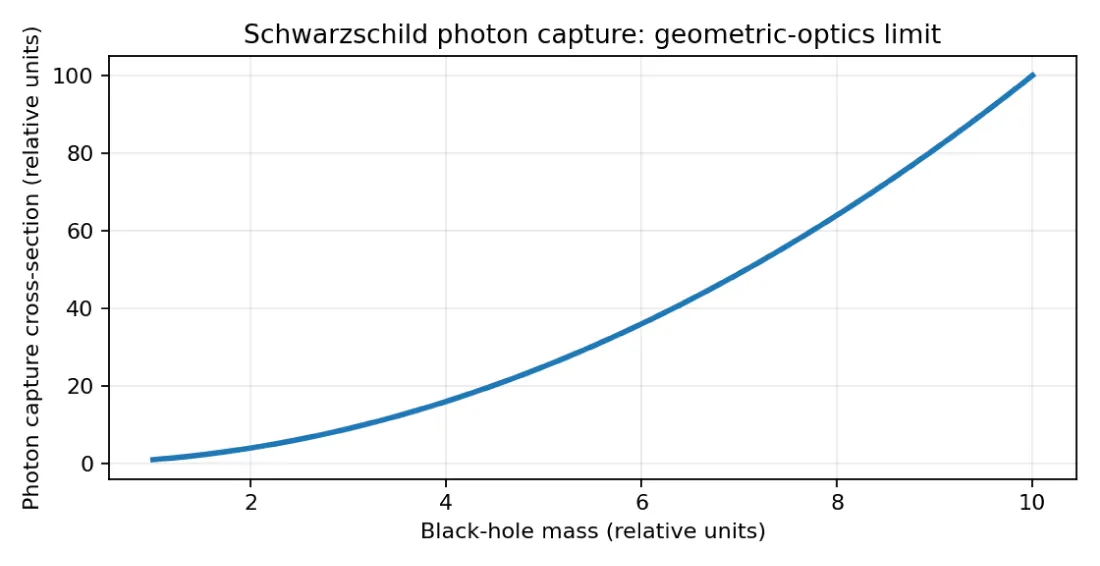
Figure 1: Established quadratic mass scaling of the geometric-optics photon capture cross-section, normalised to arbitrary reference units. This is not evidence of cross-scale recurrence.
Thus σ_geo ∝ M² for this idealised family. This is a high-frequency geometric-optics limit, not a universal frequency-independent absorption law. Wave-optical greybody factors and black-hole spin alter the detailed response [3,4].
2.3. Spectral response and dimensional bookkeeping
For monochromatic incident energy flux I_ω, absorbed power at angular frequency ω is P_abs(ω) = I_ω σ_abs(ω) when I_ω denotes the flux within the corresponding frequency channel. If I_ω is a spectral flux density, the total power is P_abs = ∫I_ω σ_abs(ω)dω. A generic dimensionless response can be defined by:
F(x; η) = σ_abs(ω,L)/(πL²), x = ωL/c. (4)
The vector η must contain all other relevant dimensionless parameters (spin, charge, couplings, masses, state, angular momentum and boundary conditions). Equation (4) is a definition, not a discovery. No physical principle presently requires a hadronic F and a black-hole F to coincide.
I introduce an indexed family of candidate systems S_n with characteristic length L_n. My strongest testable postulate is the existence of a nontrivial rescaling that maps dimensionless responses between different physical regimes: (Figure 2)
L_(n+1) = ΛL_n, F_(n+1)(x;η_(n+1)) = F_n(x;η_n). (5)
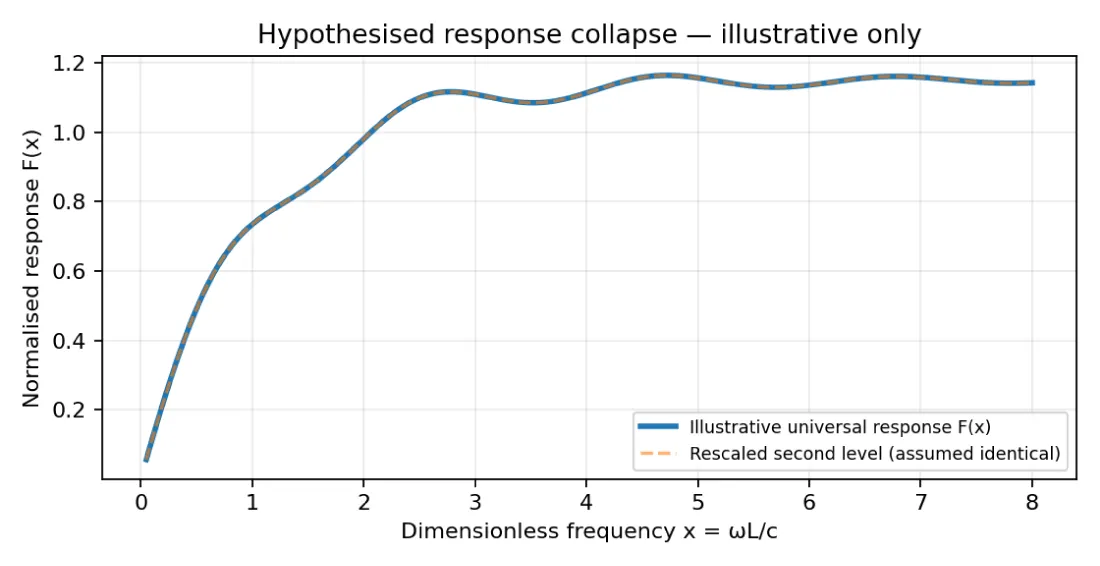
Figure 2: Schematic of the proposed dimensionless spectral-response collapse. The curves are constructed to coincide; no hadron or black-hole measurements are plotted.
For corresponding x, frequencies must satisfy ω_(n+1) = ω_n/Λ and absorption cross-sections would scale as σ_(n+1) = Λ²σ_n. This result follows algebraically from the postulate; it is not evidence that the postulate holds. A weaker hypothesis permits only matching asymptotic exponents or specific dimensionless spectral features. The strong form could be refuted by incompatible response shapes after accounting for all specified parameters.
3.1. Discrete scale invariance
With s = ln(L/L_0), a putative scale-periodic observable O obeys O(s + lnΛ) = O(s). A phenomenological example is:
O(s) = O_0 + a cos[2πs/lnΛ + φ]. (6)
This is a mathematically valid representation of discrete scale invariance, a previously studied concept [5]. It does not derive a recurrence in QCD or gravity. A new theory must obtain Λ, a, and φ from its dynamics, rather than fitting them freely.
3.2. Added definition and independent determination of the recurrence factor
I use Λ (equivalently λ in the reviewer’s notation) to denote a positive ratio of characteristic lengths, Λ=L₂/L₁. I do not currently possess a derivation showing that Λ is universal. I therefore distinguish three logically separate versions: (i) a universal Λ fixed by a common dynamical law, (ii) a system-dependent Λ specified independently for each physical pairing, and (iii) a Λ fitted from the very absorption curves being compared. Only (i), or a tightly constrained form of (ii), could support a predictive cross-regime test. Version (iii) is descriptive and cannot independently validate recurrence.
For the first comparison, I would set L_H using an independently reported hadronic size convention, such as a specified proton charge radius with its uncertainty, and L_B=2GM/c² using an independently specified Schwarzschild mass. The resulting ratio Λ=L_B/L_H would be calculated before examining spectral agreement. A hadronic charge radius is not automatically a photon-absorption radius; the choice is a modelling convention and must be tested for robustness against alternative independently justified scales.
For N matched comparison points, I would define residuals r_j=Q_H(x_j)−Q_B(x_j) and D²=rᵀC⁻¹r, where C combines hadronic experimental covariance, numerical greybody uncertainties and the propagated uncertainty in independently fixed scales. If the data share correlated normalisation errors, I would retain their off-diagonal covariance rather than treat all points as independent. A singular or ill-conditioned C would require a documented regularisation or likelihood formulation.
I would record the number p of fitted nuisance parameters and the number N of independent constraints. I would not assume D² follows a chi-square distribution with N−p degrees of freedom when interpolation, nonlinear transformations, or covariance estimation invalidate that approximation. Instead, I would simulate synthetic datasets under the specified recurrence model, repeat the entire fitting and interpolation pipeline, and calibrate the tail probability of the observed statistic. No numerical dataset, covariance matrix, parameter estimate, goodness-of-fit result, or simulation calibration has yet been generated; these are proposed future analyses and not evidence in favour of the hypothesis.
Define gravitational compactness C = 2GM/(Rc²). Under R → ΛR and M → Λ^βM with unchanged G and c:
C_(n+1) = Λ^(β−1) C_n. (7)
For Λ ≠ 1, compactness invariance requires β = 1. Hence M_(n+1) = ΛM_n is necessary for a self-similar gravitational family preserving C. It is not sufficient for a common QCD–gravity theory; a proton is not a member of the Schwarzschild horizon family.
4.1. Numerical countercheck: the proton is not a miniature black hole
Using m_p ≈ 1.6726 × 10^−27 kg and an illustrative proton charge radius r_p ≈ 0.84 × 10^−15 m gives:
C_p = 2Gm_p/(r_pc²) ≈ 2.96 × 10^−39. (8)
By comparison, C = 1 at a Schwarzschild horizon. This ~39-order-of-magnitude mismatch falsifies a naive proposal that the proton is merely a scaled-down Schwarzschild black hole with invariant gravitational compactness. Any RSCH connection must therefore change physical regime or invoke new dynamics. The proton charge radius is used only as a characteristic scale, not as a sharp particle boundary (Figure 3).
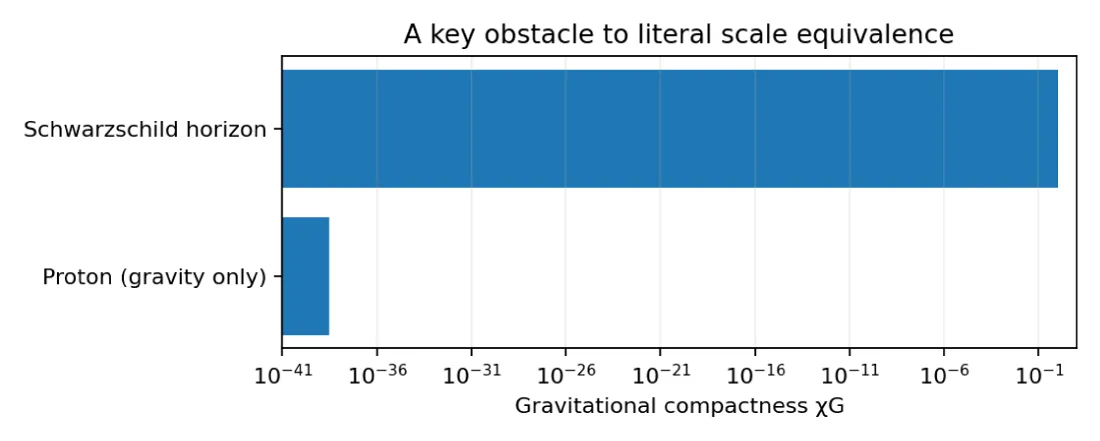
Figure 3: Gravitational compactness differs by nearly 39 orders of magnitude between a proton and a Schwarzschild horizon, challenging a literal rescaling interpretation.
Assume equation (5) holds. For a length ratio Λ = 10, corresponding spectral features move to one-tenth of the angular frequency while σ scales by 100. This is a conditional prediction at fixed dimensionless x. At fixed laboratory frequency, however, x changes; σ need not follow a simple L² law because F(x) may change. Furthermore, black holes absorb photons across a broad spectrum; increasing mass does not automatically open a previously inaccessible set of electromagnetic frequencies. In hadrons, resonance structure and electromagnetic form factors depend on internal QCD dynamics. A valid comparison must use independently calculated or measured cross-sections, not geometrical silhouettes.
Classical general relativity contains mathematical white-hole regions in maximally extended idealised solutions, but these do not establish that realistic collapse produces traversable exits. Quantum-bounce scenarios have been explored in candidate quantum-gravity approaches [6,7]. A commonly used effective loop-quantum-cosmology relation is:
H² = (8πG/3)ρ(1 − ρ/ρ_c). (9)
This model-dependent equation can yield H = 0 at ρ = ρ_c and, with suitable dynamics, a bounce. It is not a black-hole-to-white-hole theorem, nor does it connect a collapsed star to an externally accessible daughter universe. An RSCH nested-domain model would need an interior expanding metric, an exterior spacetime, and a junction or quantum transition law consistent with stress-energy conservation and causal structure.
6.1. Cosmological critical-density correspondence
For a uniform sphere M = (4π/3)ρR³, imposing the algebraic condition R = 2GM/c² yields ρ = 3c²/(8πGR²). For a spatially flat FLRW model, ρ_crit = 3H²/(8πG). Setting R = c/H makes these expressions formally identical:
ρ_crit = 3c²/(8πGR_H²), R_H = c/H. (10)
This dimensional correspondence is not proof that the FLRW universe is a Schwarzschild black hole. The geometries, global causal structures and meanings of the horizons differ. The observable-universe radius is also not generally the Hubble radius (Figure 4).
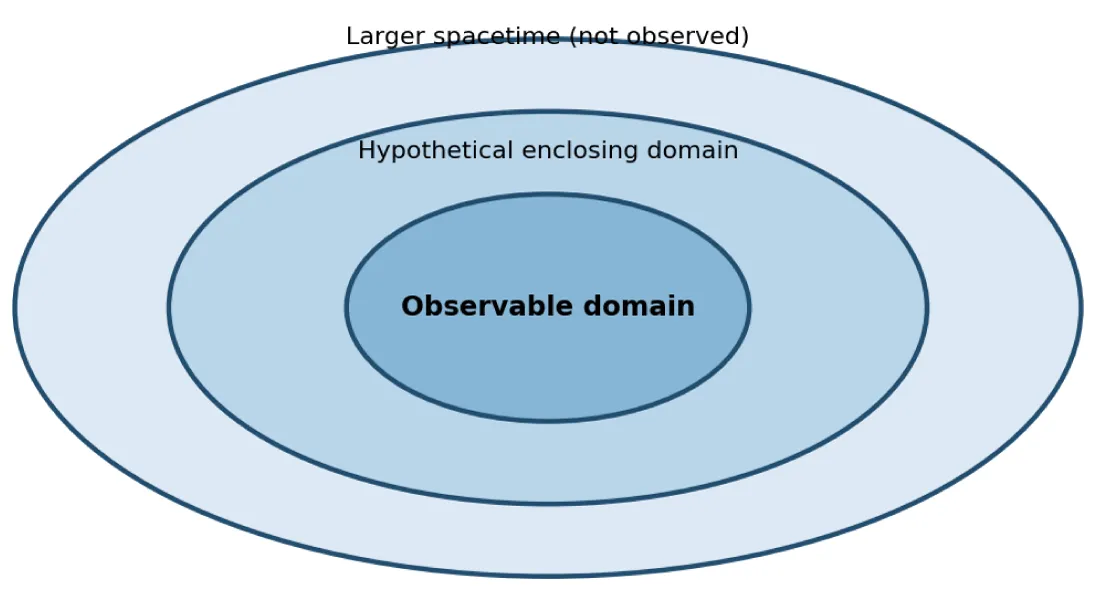
Figure 4: Conceptual illustration of nested causal domains. The boundaries are hypothetical, not an observed topology or an exact solution of Einstein’s equations.
6.2. The nucleus analogy and an illustrative scale ratio
Taking the observable-universe radius as ~4.4 × 10^26 m and the illustrative proton radius as ~8.4 × 10^−16 m gives Λ_U ≈ 5.24 × 10^41. The ratio is a dimensional comparison only; it neither identifies a physically preferred scale factor nor establishes that the observable universe is a nuclear bound state. A literal nucleus model must identify the exterior interaction, the analogue of nuclear binding, the exterior quantum degrees of freedom, and at least one observable consequence.
6.3. Added mathematical requirements for a nested-domain model
I treat the nested-domain proposal as a conditional spacetime construction, not as an established consequence of the recurrence postulate. A first model must specify two Lorentzian manifolds (M−,g−) and (M+,g+) joined across a hypersurface Σ. I choose spherical symmetry only as a tractable starting assumption; this is not a derivation from QCD.
For a candidate expanding interior, I take ds²− = −c²dτ² + a(τ)²[dχ²/(1−kχ²) + χ²dΩ²], with interior stress-energy T−μν = (ρ+p/c²)uμuν + pg−μν and a specified equation of state p=p(ρ). For a candidate static exterior, I take ds²+ = −f(r)c²dt² + f(r)⁻¹dr² + r²dΩ², f(r)=1−2GM/(c²r)−Λc r²/3, where Λc denotes a cosmological constant rather than my scale-recurrence factor Λ. These are illustrative standard geometries; their juxtaposition is not yet a solution.
I parameterise Σ by proper time s and angular coordinates, with areal radius R(s)=a(τ(s))χ(s)=r(s). The first junction requirement is continuity of the induced metric: [h_ab]=0. For a non-null thin shell, the Israel junction relation is [K_ab]−h_ab[K]=−(8πG/c⁴)S_ab, where S_ab is the shell surface stress-energy and square brackets denote the exterior-minus-interior jump. If no shell is allowed, S_ab=0 and both the induced metric and extrinsic curvature must match. A spacelike transition surface would require its own signature-consistent treatment; I cannot substitute the timelike-shell formula without checking that geometry.
I would next solve the interior Friedmann equations, the exterior Einstein equations, and the shell conservation law, verify energy and causal conditions, and determine whether the matching surface remains regular and dynamically stable. I would explicitly test whether an expanding interior can be joined to a black-hole exterior without introducing unphysical matter or an inconsistent global causal structure. No such solution has been produced in this paper. The proposed black-hole/white-hole connection and atomic-like cosmological hierarchy therefore remain a conceptual outlook, not a demonstrated nested universe.
6.4. A worked consistency check for the candidate matching geometry
I can make the proposed matching framework more restrictive without claiming to have solved the full nested-universe problem. I begin with the simplest special case: a homogeneous dust interior, zero cosmological constant, and a vacuum Schwarzschild exterior. I use this case as a control calculation because a conventional gravitational matching must be recovered before any new transition mechanism can be justified.
For a comoving spherical boundary at fixed interior coordinate χ = χb, the areal radius is R(τ) = a(τ)χb. The interior Friedmann equation, with ρm defined as mass density and k carrying the corresponding curvature units, is H² = (8πG/3)ρm − kc²/a². Conservation for pressureless dust gives ρm a³ = constant. The enclosed Misner–Sharp mass is therefore M− = (4π/3)ρm R³, which remains constant for a comoving dust boundary.
A shell-free matching to a Schwarzschild vacuum exterior requires continuity of the induced metric and extrinsic curvature. In this dust special case, the matching is consistent when the exterior Schwarzschild mass equals the interior enclosed mass, M = (4π/3)ρm R³, and the boundary follows the corresponding radial timelike geodesic. This is a known type of Oppenheimer–Snyder matching, not a new prediction of my hypothesis. It establishes that an expanding or contracting cosmological dust region can be related mathematically to a vacuum exterior under specific conditions; it does not establish a white-hole outlet or an atom-like parent universe.
The distinction becomes essential if I introduce pressure, a cosmological constant, a non-comoving boundary, or a transition layer. For a spherical timelike thin shell between two static metrics of the form f±(R), one standard junction equation, with consistent choices of outward-normal signs ε±, is ε−√(Ṙ²/c² + f−(R)) − ε+√(Ṙ²/c² + f+(R)) = 4πGσR/c², where σ denotes the shell surface mass density. This illustrative equation cannot be applied unchanged to a time-dependent FLRW interior; in that case I must calculate its extrinsic curvature directly. The shell also requires an energy-balance equation accounting for pressure and any flux across the boundary.
I therefore identify a precise existence test for my nested-domain extension: choose an equation of state and interior evolution; compute the induced metric and extrinsic curvature on a specified hypersurface; determine the required surface stress-energy, if any; check conservation and energy conditions; and examine causal structure and stability. If the construction requires an inconsistent junction, unexplained negative-energy material, or a singular transition, that candidate model must be rejected. Even a successful matching would demonstrate mathematical admissibility, not the existence of a larger atomic-scale hierarchy.
The calculation above is a consistency benchmark derived from established general relativity. My proposed new physical inference would have to arise from an additional, independently specified recurrence law that constrains the matching or predicts an observable. I have not derived that law or a unique nested-domain solution here, and I retain the black-hole/white-hole and parent-structure interpretation as a conceptual outlook requiring further work.
S_BH = k_B c³ A_H/(4Gℏ). (11)
The Bekenstein–Hawking area law [8,9] suggests that horizons encode entropy through geometry. It does not imply an identical entropy-area law for hadrons. Any common boundary functional would need to recover black-hole entropy in the gravitational limit and QCD observables in the gauge-theory limit without conflating causal and colour confinement.
A genuine unification would require an action or Hamiltonian with identifiable fields, symmetries, couplings and boundary conditions. At minimum it must: (i) reproduce the established QCD limit; (ii) recover general relativity in its tested domain; (iii) specify a boundary-response observable with operational measurement rules; (iv) derive Λ or explain why recurrence is approximate; (v) avoid violations of energy-momentum conservation and known scattering data; and (vi) supply a viable nested-domain spacetime with controlled singularities and junction conditions. The present manuscript does not supply that action. Thus equations (5)–(6) are hypotheses rather than derived physical laws.
Test 1 — Cross-regime response collapse
Calculate a dimensionless hadronic electromagnetic response from QCD (including resonances and quantum numbers) and a black-hole greybody response from curved-spacetime wave equations. Pre-register the permitted scaling map and its parameters; compare shapes and asymptotic limits. Failure to find a consistent map refutes the strongest recurrence conjecture.
Test 2 — Compactness and scaling consistency
Check whether any proposed mapping preserves appropriate dimensionless invariants. The proton compactness counterexample already excludes simple gravitational similarity; a refined model must explicitly resolve this failure.
Test 3 — Nested spacetime existence
Construct a solution with an expanding interior, consistent exterior, and specified transition surface or quantum bounce. Calculate stress-energy and junction conditions and test stability and causal consistency.
Test 4 — Distinguishing observations
Derive a parameter-constrained observable deviation, such as a scattering spectral feature or cosmological correlation, that cannot be reproduced by the relevant baseline model merely by retuning its free parameters. Compare against data with uncertainty and selection effects accounted for.
I distinguish a test of an explicitly defined model from a test of the broad idea that physical structures recur across scales. The latter is too flexible to be falsified unless I first specify the transformation, parameters, and observables. I therefore propose the following staged protocol. A failure of a particular model would not automatically refute every conceivable boundary analogy, but it would refute the model as stated.
10.1. Test A: photon–hadron and black-hole spectral responses
For each system i, I define x = ωLᵢ/c and Qᵢ(x) = σ_abs,i(ω)/(πLᵢ²). My strongest, and most vulnerable, recurrence hypothesis is Q_hadron(x) = Q_BH(x) on a specified interval [x_min, x_max]. The cross-sections must refer to physically consistent processes: hadronic photoabsorption is not interchangeable with elastic or total scattering, and the black-hole cross-section must use the appropriate wave calculation rather than its geometric-optics limit outside the high-frequency regime.
I would obtain independently published photon–hadron cross-sections and computed Schwarzschild greybody/absorption cross-sections, fix the characteristic length convention before fitting, propagate experimental and numerical uncertainties, and compare the dimensionless response curves on a predeclared common interval. I would not introduce a free frequency warp merely to produce a visual match.
A possible diagnostic is D² = Σⱼ [Q_H(xⱼ) − Q_B(xⱼ)]²/δⱼ². Here δⱼ is only shorthand: a publishable analysis should replace independent-error denominators with a covariance matrix C and calculate D² = ΔQᵀC⁻¹ΔQ. Its significance must be calibrated for interpolation, correlated uncertainties, and fitted nuisance parameters. If the fixed hypothesis yields a discrepancy outside the predeclared acceptance region, that strong recurrence model is rejected.
10.1A. Added operational comparison, baseline and rejection rule
I specify the first proposed numerical comparison as inclusive real-photon absorption on a proton, γ+p→hadrons, versus absorption of an incident electromagnetic (spin-1) wave by a non-rotating, uncharged Schwarzschild black hole. I exclude elastic Compton scattering from the hadronic absorption channel. The proton data would need a documented energy interval, threshold treatment, experimental source, and complete statistical and systematic uncertainties. The black-hole curve would be computed from spin-1 partial-wave transmission probabilities, including enough angular momenta to demonstrate convergence, rather than extrapolating the geometric-optics area into the low-frequency regime.
I would transform both curves to Q_i(x)=σ_abs, i(ω)/(πL_i²) and x=ωL_i/c, using the same angular-frequency convention, ℏω=E for the photon. I would fix L_H from an external hadronic measurement and L_B=2GM/c² before looking at the response curves. I would predefine the overlapping x interval and avoid comparing unmatched threshold regions or changing the energy axis after seeing the result. I would propagate experimental covariance, scale uncertainties, numerical truncation errors, and interpolation uncertainty into the comparison.
My primary null benchmark would be a no-correspondence model in which each response is described by its own independently established physical calculation or empirical interpolation, without imposing equality of the dimensionless shapes. The recurrence model is the restricted hypothesis Q_H(x)=Q_B(x) over the preregistered interval, with no free horizontal warp. I would also test whether apparent agreement is explained by generic asymptotic behaviour shared by unrelated absorbers, rather than a unique boundary principle.
I propose a two-sided significance threshold of α = 0.05 for the predeclared strong-recurrence goodness-of-fit test, calibrated by simulations that reproduce the full covariance and fitting procedure. A calibrated p - value below 0.05 would reject that specific equality model. A p - value at or above 0.05 would mean only that this test had not rejected it, not that recurrence was established. Any claimed improvement over the no-correspondence benchmark would also require an explicitly stated model-comparison criterion, accounting for parameter counts and look-elsewhere effects.
This study has not yet been performed. I do not report measured agreement, a fitted recurrence factor, a numerical test statistic, or an uncertainty interval. Obtaining independently sourced hadronic photoabsorption data and a reproducible spin-1 greybody calculation is the minimum quantitative task required before I can claim empirical support for the proposed correspondence.
10.2. Test B: discrete scale invariance
For a systematic literature review, I would compare each prior model by its physical degrees of freedom, governing equations, treatment of confinement or horizons, scale parameters, predicted observables, and falsification criteria. I would not treat shared terminology or visual similarity as proof of physical equivalence. The reference list already identifies foundational QCD, black-hole absorption, discrete-scale invariance, quantum-bounce and black-to-white-hole work; a submission-quality priority assessment must verify and extend that literature search.
I define s = ln(L/L₀) and consider the explicit conjecture O(s + ln Λ) = O(s) for a named dimensionless observable O. A candidate signature is O(s) = O₀ + A cos[2πs/ln Λ + φ]. This is an ansatz, not a derived law. I would require Λ, the permitted phase range, and a non-zero lower bound on |A| to follow from the model before looking at the data. Otherwise, a non-detection cannot falsify the hypothesis.
A pre-registered analysis would test the specified log-period against null models with smooth scaling and instrumental/systematic structure. Exclusion of the predicted amplitude and period at the chosen confidence level would reject that version. A positive log-periodic signal alone would not uniquely establish boundary recurrence because other mechanisms can produce similar patterns.
10.3. Test C: black-hole ringdowns
For Schwarzschild geometry, characteristic quasinormal-mode frequencies scale as f_QNM ∝ c³/(GM). A proposed modification can be parameterised as f_model = f_GR(1 + ε), but ε is not presently calculated from my boundary principle. Before any gravitational-wave test, I must derive ε as a function of mass, spin and mode number, including whether ε must differ from zero. Observations consistent with general relativity then constrain or exclude only those parameter regions for which my theory makes a definite prediction.
10.4. Test D: cosmological nesting and primordial perturbations
A nested-domain model would need a metric, matter content, junction conditions, and an evolution equation for perturbations. I would then calculate an explicit departure from a baseline primordial power spectrum: P_R(k) = A_s(k/k_*)^(n_s−1)[1 + δF(k)]. The function δF(k) cannot be chosen after inspecting cosmic microwave background observations. It must follow from the nesting dynamics. I would propagate the predicted primordial perturbations into observable angular spectra and compare them with published CMB likelihoods, including the standard cosmological parameters and known degeneracies.
If the model requires a CMB feature excluded by the data, that nested-domain realisation is falsified. If the exterior larger structure produces no accessible observable at all, the claim that our universe is a nucleus-like interior remains metaphysical or underdetermined rather than experimentally verified.
10.5. Mathematical no-go checks
Before interpreting any data, I would test whether a candidate action has well-defined field equations, conserves the appropriate stress-energy tensor, reproduces tested QCD and general-relativistic limits, respects dimensional consistency, and avoids unstable or unphysical degrees of freedom. I would check causal structure and matching conditions for any black-hole-to-expanding-region transition. A contradiction with these requirements would defeat the candidate mechanism even in the absence of new observations.
10.6. Decision rules and publication standard
I propose to register the chosen observable, the parameter values or prior ranges, the datasets, the null model, the treatment of systematic uncertainties and the statistical rejection criterion before analysis. I would report both favourable and unfavourable comparisons, with reproducible code and source data. The first practical study should be a constrained calculation of Test A; Tests C and D must wait until the theory derives quantitative non-zero corrections. No experiment or statistical fit has been performed in the present manuscript.
The statement that the observable universe is a nucleus of a larger atom can mean either a literal composite object or a structural analogy. The literal version requires identification of exterior constituents, an interaction law, a scale hierarchy and an observable coupling to our region. The analogy version makes the narrower claim that distinct theories can share a boundary-response principle. I adopt the latter as the presently tractable mathematical research programme while retaining the former as an explicitly speculative extension.
Analogies between elementary particles and black holes, discrete scale invariance, black-hole cosmology and quantum-bounce proposals all predate this manuscript [5–7,10]. Accordingly, RSCH does not claim priority for those broad concepts. Its proposed contribution is the joint, operational formulation of a boundary-response scaling test spanning QCD and gravitational photon capture, together with explicit counterchecks and requirements for a nested-domain extension. No comprehensive priority search or independent expert assessment has yet established novelty. The hypothesis currently has no demonstrated new empirical prediction and should be evaluated as a research proposal, not a completed physical theory.
12.1. Added comparison with existing literature and precise novelty statement
I distinguish four strands of prior work from the inference I am attempting. First, QCD confinement and black-hole analogies have been explored previously, including comparisons of effective actions and thermodynamic behaviour. Those analogies do not by themselves imply a universal mapping between real-photon absorption by hadrons and electromagnetic-wave absorption by black holes. Second, black-hole cosmology and baby-universe proposals predate this paper; their existence as theoretical possibilities does not establish that our observable universe is the interior of a larger atomic-like structure.
Third, discrete scale invariance is an established mathematical concept, including log-periodic observables. Writing L_(n+1)=ΛL_n or a log-periodic ansatz does not constitute a new derivation of Λ. Fourth, quantum-cosmological bounce models and black-to-white-hole transition proposals depend on particular dynamical assumptions; they cannot be taken as evidence that my nested-domain extension follows from standard general relativity.
The familiar relations σ_geo=27πG²M²/c⁴ and χ_G=2GM/(Rc²), and the resulting mass–length constraint under fixed compactness, are established calculations or algebraic consequences. I do not claim them as discoveries. My candidate contribution is the explicit, cross-regime and potentially falsifiable conjecture that independently normalised electromagnetic absorption responses might coincide over a specified dimensionless frequency interval, with the scaling lengths fixed without using the absorption data.
The minimum quantitative prediction of the strongest version is Q_H(x_j)−Q_B(x_j)=0, within independently propagated uncertainty, for every predeclared comparison point x_j in the common interval. This is a conditional prediction of an assumed correspondence, not a new result derived from a fundamental action. If the curves differ beyond the calibrated rejection threshold, that version is falsified. If they agree, further work must establish whether the agreement is nontrivial, unique, and dynamically explained. At present, originality resides in the proposed combination and test design; I have not demonstrated a new physical law or an empirically supported cross-scale correspondence.
I have derived three defensible results: (i) the Schwarzschild geometric-optics photon-capture area scales as M²; (ii) invariance of gravitational compactness under a nontrivial length scaling requires mass to scale linearly with length; and (iii) a proton’s compactness differs drastically from that of a black-hole horizon. I have formulated, but not proved, a proposed dimensionless boundary-response recurrence and identified the additional gravitational mathematics required for nested cosmological domains. These constraints preserve the motivating possibility of cross-scale structure while ruling out naive size-only equivalence. The next necessary contribution is a dynamical derivation or a sharply parameterised falsifiable prediction.
Declarations
Funding: None declared. Conflicts of interest: None declared. Data availability: No new datasets were generated. Computational methods: Algebraic derivations and illustrative numerical estimates; no numerical simulation or statistical inference. Author contributions: Conceptual hypothesis and manuscript authorship attributed to D. W. Ribbands.
- Gross DJ, Wilczek F. Ultraviolet behavior of non-Abelian gauge theories. Phys Rev Lett. 1973;30(26):1343-6. Available from: https://dx.doi.org/10.1103/PhysRevLett.30.1343.
- Wilson KG. Confinement of quarks. Phys Rev D. 1974;10(8):2445-59. Available from: https://dx.doi.org/10.1103/PhysRevD.10.2445.
- Sanchez N. Absorption and emission spectra of a Schwarzschild black hole. Phys Rev D. 1978;18(4):1030-6. Available from: https://dx.doi.org/10.1103/PhysRevD.18.1030.
- Page DN. Particle emission rates from a black hole: Massless particles from an uncharged, nonrotating hole. Phys Rev D. 1976;13(2):198-206. Available from: https://dx.doi.org/10.1103/PhysRevD.13.198.
- Sornette D. Discrete-scale invariance and complex dimensions. Phys Rep. 1998;297(5-6):239-70. Available from: https://dx.doi.org/10.1016/S0370-1573(97)00076-8.
- Ashtekar A, Pawlowski T, Singh P. Quantum nature of the Big Bang. Phys Rev Lett. 2006;96(14):141301. Available from: https://dx.doi.org/10.1103/PhysRevLett.96.141301.
- Haggard HM, Rovelli C. Quantum-gravity effects outside the horizon spark black to white hole tunneling. Phys Rev D. 2015;92(10):104020. Available from: https://dx.doi.org/10.1103/PhysRevD.92.104020.
- Bekenstein JD. Black holes and entropy. Phys Rev D. 1973;7(8):2333-46. Available from: https://dx.doi.org/10.1103/PhysRevD.7.2333.
- Hawking SW. Particle creation by black holes. Commun Math Phys. 1975;43(3):199-220. Available from: https://dx.doi.org/10.1007/BF02345020.
- Smolin L. Did the universe evolve? Class Quantum Grav. 1992;9(1):173-91. Available from: https://dx.doi.org/10.1088/0264-9381/9/1/016.